Letting go of self is NOT the same as losing control 🙂
I wish I’d waited till today to write about letting go of self because there was a great example in the Netflix series I was watching.
It all starts to unravel as secrets are reveal. One husband says things like “how are you feeling now?” and “I’m so pleased you are finding you” and even though he looks sad when she says that she truly loved the other guy he reaches out to put his hand on her to comfort her. This character let go of self and cared more for his wife than for himself.
The other husband lost it completely with his wife. He screamed and railed at her, refused to let her be with their daughter, and kept shouting “what about my reputation?” “how am I going to walk down the street now?” “I a ruined”. Even their sister talks all about how this revelation has ruined her life.
Letting go of self is to put yourself in the other person’s shoes and, even if it hurts, put their comfort and their needs first. How many of us could really do that?
Interestingly as the series continues it is those who are angry at their own hurts that the story concentrates on. The self-less husband disappears from the story. It makes me wonder if in reality we like to blame others and keep our feelings in the centre.
Only with healing, by knowing we are loved unconditionally and being accepting of ourselves are we ever going to be willing to let go of self, I think.
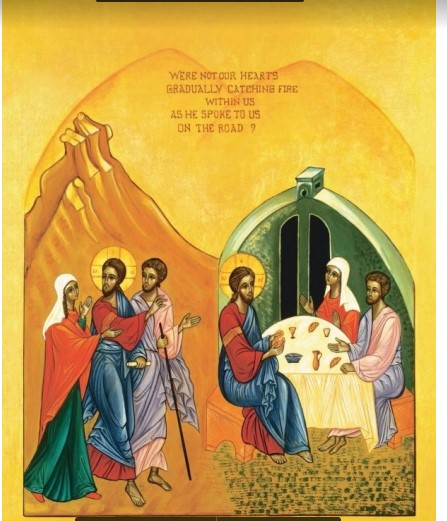
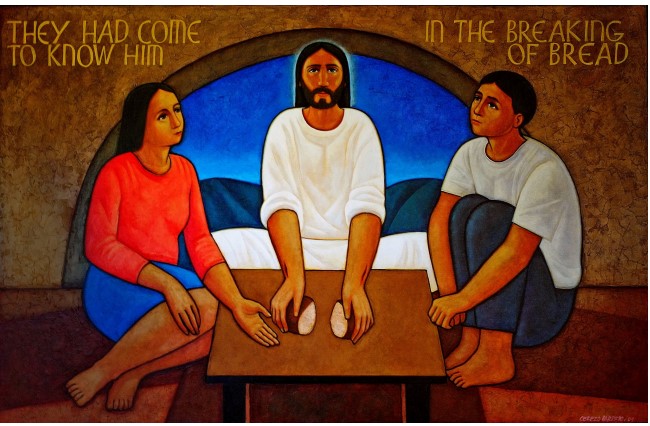
So maybe this happened Easter Sunday but there’s enough going on I thought I’d share this to. Found in Luke 24:12-35
Scholars like NT Wright and Wayne Grudem have argued that maybe Cleopas was walking home with his wife Mary The artists are Sr Marie-Paul Farrar OSB and Maximo Cerezo Barredo who painted several versions of the meal. Thank you to David Pott for bringing this to my attention.
How often does someone take something, decide they are seeing it as it should, gone on to tell others and that has become fact? It isn’t just in preaching from the pulpit but in many areas of life.
In this story it mentions “that same day two of Jesus’ disciples were going to the village of Emmaus”. It then goes on to mention Cleopas by name. Cleopas has never had a mention in any Jesus stories up to now but he is named by Luke the historian as a disciple. The other disciple never gets a name. It also never says if they were traveling just the two of them. They may have been with a crowd of friends who were not classed as disciples by Luke. So to just says “two of Jesus’ disciples” is accurate but not necessarily the whole story. It could have been just Cleopas and a friend; just Cleopas and his wife, who was also a disciple; Cleopas, his wife and a friend, two of whom were disciples; Cleopas with a small group of people heading home dejected after what had gone on, where Cleopas and someone else were disciples.
It amazes me how we are so quick to make assumptions, which with many of the Bible stories then get “set in stone” by years of preaching. And even with this new thought with these paintings and two amazing scholars making us look at it differently. We do still have to be very careful we don’t take this as the true and accurate picture.
The other day a friend of mine was talking about someone who was self-harming. God led me to pray for this person and I was able to suggest an idea to help my friend help her friend. My friend said this was very helpful because this friend of hers was very intelligent and was a retired professional. Well because I’d been told this person was self-harming I had a picture of her in her 20-30s, brassy blond hair with money problems. My friend hadn’t said that. There was nothing in her narrative that told me that but that was my stereotype from the information I have bubbling around in my brain.
So this is why I think we have to be really careful about how we stereotype and pigeon-hole things. Just because the person in authority in church has been telling us this for many years does not make it true.
But as I was reading this story and writing this blog it suddenly struck me – why did Jesus go and meet up with these people; be they 2 or many? What was it about them that was special?
In Luke’s account we have the women going to the tomb with spices and being told by the angel that Jesus was risen. They then go back to tell the “eleven apostles” [Luke 24:12] who think it is nonsense. Though Peter does go to have a look for himself. So why is Luke’s next scene of the risen Jesus with these two disciples on the road to Emmaus – a place that is not named previously and a disciple who is not named previously?
I think this is why we need to really get lost in the scripture. Most of the Bible is not a great way to learn about storytelling because it comes with many plot-holes. But it is an amazing place to not take things as given, to spend time listening to many different opinions but also spend time exploring it for yourself.
And the exciting thing, because the Bible is called the LIVING WORD of God then it will keep changing depending on how you read it and what God needs to highlight for you. Now that is exciting.
A skeleton found on a dig at Lindisfarne. Probably 700-1500 years old. Photographed by myself Sept 2022
I start with the archeological dig’s skeleton, because we are all going to die And as an old dog walking colleague once said, his Mum died when she was in her 90s and it was still 10 years too soon for him. And I was reminded of the shortness of life last week when my daughter messaged to say her ex-boyfriend’s current girlfriend had died suddenly in the night, probably of meningitis. This girl was only in her mid 20s. Too quick and too soon.
But there was a quote a read on Instagram, which I can’t find again, about how life is short and yet we learn to fear each other rather than love each other. I wish I could find it again because it is really good. Then I heard on Cunk on Earth’s Faith episode, about how Christianity preached love and forgiveness and then killed anyone who would not practice it!!!
These things over this last week have left me wondering why we do not love and forgive more than we hold grudges and fear people. I think it is fear rather than hate. Hate I believe comes from fear. As I keep saying the more I do QEC counseling the more accepting I can be of others, but also the more I see that it is my traumas and fears that used to hold me back from forgiving and accepting people than the people themselves.
This isn’t to say that I am swinging my doors wide open to fill my house full of people. That is something I have learned that I do not like and find hard. That is not to with others but to do with me. But it does mean that I can smile at people when I’m out, engage in conversation where I am listening to them, where I am not worrying about how I will look or if they might “get one over on me”. Instead I am accepting myself and them, giving us both/all our space to be who we are, realising when I react to something someone has said it is as much my issue, if not more so, than their fault.
I think, as I get older, my greatest wish is to be accepting of myself fully, forgiving of myself fully, accepting of others fully and forgiving of others fully. Some of these issues I will have to work through with QEC and other stress/trauma calming techniques. But that is my greatest wish to reach a point where I can appreciate all people and myself, and that all people can do that for each other.
I’m ending this now as I can feel myself going into a rant about governments, etc and I want to keep this post free of that. Maybe next time?? 🙂
Godspace is running a series about Hospitality at the moment with lots of info on cooking and having people come into your home. Now I am someone who loves cooking for people, but I remember a friend who really was worried when she first started getting involved with church because she was not a good cook and also had children who did not like people coming into their house. She did doubt whether she was a “good Christian” or not; whatever that phrase might mean.
But one of the things that struck me in Christine Sine’s post for Monday was about being a “good guest”. We can all come as guests. We don’t need to bring anything apart from ourselves. But what does it mean to be a good guest?
Well for me I get upset when people to my house and bring extra food. I get upset by that because I will have provided more than enough. Though I do love it when they bring wine, chocolates, and/or flowers. All those things to me say they are happy to come to my house. When my sister-in-law first came to stay at our house she brought her own towels. I was hurt by that because I wanted to lavish hospitality on her but she wanted to “save me too much trouble.”
I think when we come as guests of God to the table I think we should come knowing that it is not too much trouble for God to lavish things on us. Of course we shouldn’t trash the place. As those who have been reading my blog for a while, pre-covid I did Airbnb. I enjoyed it but really got upset if guests did not respect my home and left things in a mess.
So as guest of God we should bring those extras – the spiritual equivalent of wine, chocolates and flowers, which often is nothing more than our open hearts. But we should respect those who are joining us, should respect God’s creation, should respect God’s home – which is our earth.
Also I love having guests who delight in being in my home and delight in being with the people who have also come to the table. So as God’s guests we should delight in being invited, delight in those God has chose to be with us for this season of our lives.
So to be a good guest then it to delight in being there, and not think we need to add to what God has done, to respect the space God has opened for us and those who are also invited to that self same space, and come wanting to be lavished on. If you come like that when I invite you I will be most pleased. And I am sure if you come like that God then they will be most pleased too.



 Aspirational Adventures