Categories
Magi surrender

Wise People’s Gifts

I’ve been looking at different thoughts and things around those wisemen that came to visit Jesus and their gifts. What if those gifts don’t represent what we’ve always been told they represent. There is nothing in the Bible that says why they gave the gifts, it just says

On coming to the house, they saw the child with his mother Mary, and they bowed down and worshiped him. Then they opened their treasures and presented him with gifts of gold, frankincense and myrrh.

Matthew 2:11

Then they go home again a different way.

So what if GOLD, to these wisemen, represents their worldly wealth? What if they prophetically looked at this baby and were willing to trust all their worldly wealth, all their earning power to Jesus? These wisemen must have been rich because they travel from Persia to Judea and Herod welcomed them as equals – and he was a proud, image-focused human. These wisemen could afford to take time off of making money to journey for weeks with an entourage – not just the 3 of them that we see on on Christmas cards – but a whole entourage of baggage, of guards, of food, of water [yup you need lots of water to cross a dessert] It says too that they “open their treasures” not that they just slid over a few presents. But they looked in their treasure chests and they decide from there what to give. That took a camel or two of its own to carry plus guards so they weren’t robbed.

So maybe Gold represents trusting God from now on for earnings, for wealth, for the financial security that gold, that jobs, that money brings to us all.

I wonder if FRANKINCENSE represents one of the tools of their trade. These were astrologers, star gazers, fortune tellers. A lot of the people I know who tell fortunes, who do divining, and those sort of things use incenses in many ways – to help with the atmosphere, to help calm, to help even open a portal to another dimension. What if these wisemen were giving this gift to Jesus because they were saying that they no longer needed to create an atmosphere by altering states of mind, they didn’t need to even keep the illusions of their trade up any more? Maybe they were handing the tools of their trade over to Jesus and trusting that God would do whatever with their skills and talents.

Now to MYRRH which we’ve always been told they gave to Jesus foretell his death. Myrrh is an embalmer. They were also a wealthy class of people living in a culture where tombs were built and prepared long before the recipient died, and generally orchestrated by the person who was going to be buried in there. The living person was keeping control of their death and afterlife!! What if they gave myrrh to Jesus because they were saying that their death – the timing, the manner, how they were buried – was no longer in their hands, that they no longer had control over it. That as they had given over control of their wealth, their earnings, their trade to the living God so they were giving control of their death to God.

Maybe all three gifts were to show that, rich and important as they were, they were letting of all that and giving it into the hands of this baby who they knew, through their prophetic eyes, was God Incarnate – someone they could trust not just with their lives but with their deaths?

Categories
being real no agenda

Tis The Season Of The Resolution

I’m randomly scrolling through Facebook and watching TV and entering into 2026 with a sense of chilledness with a dog either side of me snoring gently.

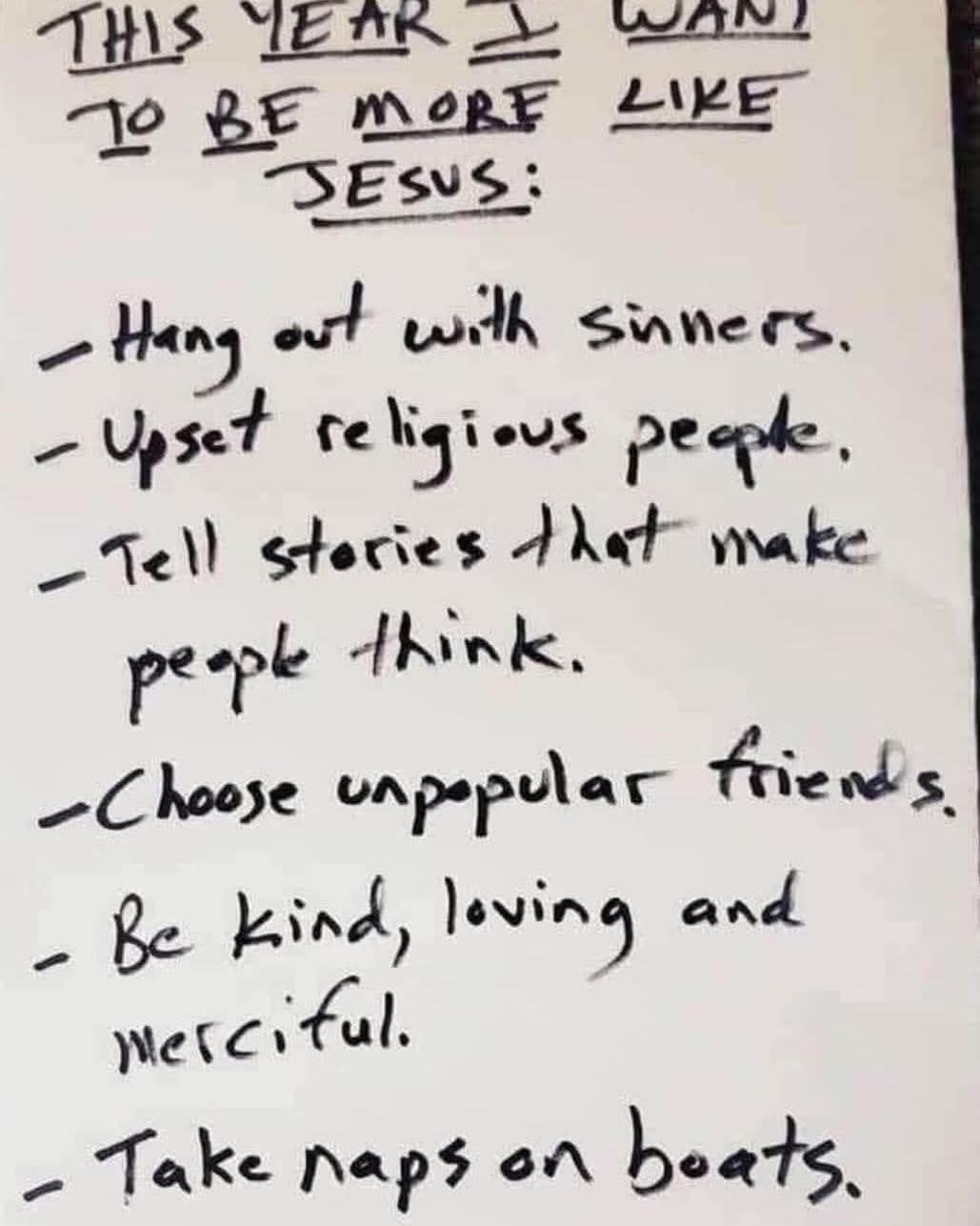
As I Facebook-scrolled I came across two contradictory posts. Now as a Christian I know there is an expectation that I should follow this one

but something in this made me uncomfortable. I also find it amusing because it is posted by a church leader. I wonder how he’d feel if I went into his church and did things to upset him????

Also I do think religious leaders are doing a great job and I wouldn’t want to deliberately upset them. There are times when, yes they do make mistakes, get things wrong, get too caught up in one theology or way of doing things, but I know I wouldn’t like the job. I’d love doing the sermons and hanging out with people but I’d hate to try to lead an organisation full of fallen, sinful, often unpopular people. So yes there are times when I know I’ve upset religious leaders but I didn’t set out to do that. Also I’m not sure Jesus did.

I think Jesus loved those people so much that he wanted to help them see that their rules and religiosity weren’t doing them any favours. Though my daughter used to say that she thought Jesus was upsetting the religious leaders of his time by doing healings on the Sabbath. To me that is a great question to debate. Maybe another blog post???

Also if we take the verse “all have sinned and fallen short of the glory of God” [Romans 3:23] means that everyone we hang out with are sinners. Though I’m sure this person is meaning noticeable sinners, those ones we can chalk up as “look at who I’m being friends with”.

For me I choose my friends by who God places across my path and who I feel led to be with. Some are people others like and some are ones others don’t, but I can’t think of any who would be labelled “unpopular”. Also by the time they are my friends I wouldn’t notice whether they are popular or not. They are just “my friends”, the lovely eclectic mix of them. Also it is why I did personal new year messages to my close friends, because they are not a generic “friendship group”.

Unfortunately this isn’t the post that I reacted to initially but by the time I tried to find it -and it was almost directly opposite of the above about being careful who you’re friends with because you need to look after your own heart and well-being. That old adage of “put your gas mask on first” which I’ve seen many Christians think isn’t “Christ-like” and have charged in hurting and being hurt.

Anyway this the nearest I can find. It’s from Tiny Buddha – and often I find I can relate to the Tiny Buddha posts more than the evangelical Christian ones.

To me this is the God I follow, this is the Jesus I see in the gospels – someone who noticed what was around them, who loved people so much he was willing to give his whole life to them, was grateful always even to the end, saw the beauty in things and took things slowly. I think Jesus did what he did because he was going slow, was deeply observing things, and did as he knew needed to be done at that moment in time. I don’t think Jesus picked his friends because they were “sinners” or unpopular or any other criteria. I think he picked them because he saw them and knew them for what they truly were. And that’s how I want to be.

Yes I will do my best this year to walk with kindness, love and mercy, but also with peace, dignity, gratitude and trust. I’ll be my best not to pick those I see and the things I do with any agenda other than what I notice as I move gracefully through the day – with a manic dog on each arm [Definitely getting a 3 year old chug is a lesson in patience and perseverance!!! 🙂 ]

Willow and Renly, Newborough Beach 28th December 2025

Categories
Rachel Weeping

Belated thoughts on 28th December – Murder of Innocents

A belated post due to lots of dog training, beach and mountain walking and inertia!

I wrote a really fun play for my youth group which they performed on Christmas Eve looking at the nativity story from the point of view of Mary’s donkey, the Shepherd’s sheep and the wisemen’s camel. I also added in a dragon to show how the enemy tried to thwart God’s plans without success. Though there was always the bit that I had to miss out because it was a family/children’s service – and that was the murder of the innocents by Herod after Jesus and his family escaped to Egypt.

16 When Herod realized that he had been outwitted by the Magi, he was furious, and he gave orders to kill all the boys in Bethlehem and its vicinity who were two years old and under, in accordance with the time he had learned from the Magi. 17 Then what was said through the prophet Jeremiah was fulfilled:

18 “A voice is heard in Ramah,
    weeping and great mourning,
Rachel weeping for her children
    and refusing to be comforted,
    because they are no more.”

Matthew 2:16-18

There’s been a lot of talk this year about Jesus being a refugee and how one needs to be generous and supportive to refugees [which is only right and proper] but how do we deal with those babies who got murdered?

Many Bibles headline this piece “the murder of innocents” – so here’s my question “What do we about the continued with the murder of innocence?”

Yes still today, and possibly more so than ever, the innocence of children is being eroded. As I write this I’m also watching TV and seeing the contrast between the innocence of the film Chitty Chitty Bang Bang and the adverts. The adverts are telling me that taking my children to a regular playpark is boring and that I should be taking them to Butlins where there is light and noise and implied fun. The simplicity of swings, slides, overcast days, regular cornflakes, is now seen as boring. The innocence of childhood continues to be eroded.

I read a great piece in a book called “Going Home Another Way” a devotional for the Twixmas time. For the 28th December there was a piece by a man who’d lost his leg when he was five and he talked about the youth he worked with and why it was the more difficult youth who were attracted to him. And he says he believes it is because he lost his innocence at five when he had his leg amputated and they have lost their innocence with things like their home life, their parents, their friends, etc.

These were children in poorer areas but I think so many young people lose their innocence due to expectations, materialism, “having to do well”, and more. I’m sure we can all name things that took away our innocence long before it should have been and it has caused us to make many of the life choices we do.

I got this via an email on 28th December and I think the first bit is great but I’d change the last line

Innocent’s Song by Charles Causley


Who’s that knocking on the window,
Who’s that standing at the door,
What are all those presents
Lying on the kitchen floor?


Who is the smiling stranger
With hair as white as gin,
What is he doing with the children
And who could have let him in?


Why has he rubies on his fingers,
A cold, cold crown on his head,
Why, when he caws his carol,
Does the salty snow run red?


Why does he ferry my fireside
As a spider on a thread,
His fingers made of fuses
And his tongue of gingerbread?


Why does the world before him
Melt in a million suns,
Why do his yellow, yearning eyes
Burn like saffron buns?


Watch where he comes walking
Out of the Christmas flame,
Dancing, double talking:


Herod is his name.

But I think by saying “Herod is his name” we’ve missed out on being responsible for the loss of the innocence of our children – whether we’ve given birth or not. I think “Herod” could easily be changed to “materialism/expectations/being too busy” and I’m sure there are many more.

Perhaps the Rachel’s of this world now need to keep weeping for our son’s who have lost their innocence and refuse to be comforted until something changes?

Categories
Appreciate freedom

Jesus Light Of The World

 In the beginning was the Word, and the Word was with God, and the Word was God. He was with God in the beginning. Through him all things were made; without him nothing was made that has been made. In him was life, and that life was the light of all mankind. The light shines in the darkness, and the darkness has not overcome it.

John 1:1-5

Too often, I think, we see the “darkness” as the world around us – wars, greed, poverty, world leaders, etc etc and we pray that “they” will change. Yes those things are darkness things. But I think too often we forget the darkness within each one of us, the darkness that makes us fearful, anxious, worrying, not able to give freely, not able to fully lean on God and trust them, that makes us always need answers rather than to live in the mystery.

For me this video from Instagram says much clearer what we can be like when we let the darkness take over and also how we can be. [Do try to watch it all because it helps make this post make better sense if you watch all of it]

So are we willing to do the work, to let Jesus, who is the light of the world, shine into our own dark places? Are we willing to surrender our dark places to a God we cannot see, often cannot understand, and who sometimes seems to do things we rather they didn’t do?

But if we are willing to do that via whatever means that change the thoughts that are so deeply imprinted in our minds then we can be like the guy on the video – at peace and appreciating what is around us.

Categories
simple Still

Be Still And Know

Be stilland know that I am God; I will be exalted among the nations, I will be exalted in the earth.”

Psalm 46:10

This was a verse that was given to me on a bookmark over 30 years ago when I first met with God and I’ve been pondering it every since.

What struck me in church on Sunday was – this is not a moment in our day when we take a “mindfulness moment” but it is a lifestyle. The whole of our life and our existence should be still, calm, at peace, knowing that God has it all covered and that our whole role in the whole salvation of all the peoples of the world is just to be still and to know that God is God. But I think too often we see this as a moment not a whole.

So we take a moment to be still and then we go back to worrying, doing it in our own strength, stressing, when we can just still our whole minds and bodies and believe

This isn’t easy but, from what I’ve learned from QEC and being able to bring my autonomic nervous system into line regularly then it is possible to keep “resetting” and returning to that still and trusting place whenever we notice we’re not there 🙂

So simple!

Categories
let go Trust God

The Greatest Sin

for getting to put God and Jesus in the centre of all we are and all we do.

The sky on our drive home on Tuesday looking towards Eryri photographed by myself whilst in the car hence why it is a bit blurry.

When we go to the Anglican church there is always a prayer of confession which talks about repenting for things we’ve done and things we’ve not done but last week it stuck me that one of things we don’t repent of is not putting Jesus in the centre of things, of not trust that God has a plan through it all. Surely that is one of our main tenants of faith – that God works all things to good [Romans 8:28] – yet too often we don’t believe it. Instead we try to do it on our own, with our own skills, with our own strength. Ok so we might pray that prayer “Jesus help me with my work/family/this situation/this decision I have to make” but then we get back to working out the answer, of putting together pros and cons, putting together contingency plans, and worry and worry and worrying. And so we get stressed, grouchy, and of course that can lead to various health issues if we read Gabor Mate, etc.

Over the last month or so we’ve had loads of curveballs thrown our way from family issues to car issues to boiler issues to getting a rescue dog – something we wanted but maybe the timing was out? I found I was getting more and more stressed and so not being able to see through things and not being able to truly enjoy the new dog.

This is our something good – a new dog called Willow who our old dog Renly gets on well with

We all have deep-seated different motives for why we take on board what we take on board. For myself I wanted to “get it right”, to “please everyone”, and to “be a good girl”, and to “prove myself”. None of which are what God wants.

So how does one put God at the centre? It is really hard work but also really easy. For me it was to trust that God knew that all these things were going to happen at this time. God also knew I could handle them, but not in that way that I had to sort it all out by myself but that I was able to rest with God and let them deal with all the curveballs. I don’t even need to catch the curveballs. That is God’s job.

I do have to be willing to let go of controlling outcomes. Not that any of us can control outcomes anyway but, oh my goodness, we all do try very hard to keep control of all situations, which just leads to more stress. If God was willing to give each of us freewill surely we should let our family and friends have freewill, even if we think we know best or could do better.

So once I’d let go of it being my responsibility for sorting other people I could hear what God wanted me to do in those situations – to be able to leave my old and new dog peacefully with a friend as I went away, to leave relationships for God to sort and not see them as a reflection of me. And I do think we too often see the way our children, especially, behave as a reflection on ourselves and how we brought them up. Instead of being as gracious as God is with us and letting them have the freewill to do what they want. That doesn’t mean we don’t pray for them but it must be a freewill prayer filled with love and grace. I think we can pray “your kingdom come” in both personal and world situations but we cannot pray “your kingdom come and it looks like X,Y,Z” because, for one, that is controlling and, two, we really really do not know the whole situation but God does.

So for me with all that was going on I was able to turn my heart toward God, to trust them in all things, to let go of trying to control and to hear what I am to do. Interestingly this has made settling the new dog into the family much easier and has helped me sleep better. Has it sorted the other things out? No! But, even though I care, I know they are not mine to sort.

So I have put Jesus back into to the centre of my heart and my life – though of course have to keep turning back to doing that again and again and again – and my life becomes much simpler.

God is good when we acknowledge that they are.

Categories
questioning temple

Details!

AI has created this angelic picture of Jesus as a boy in the temple. It seemed intent on making sure he had a beard. Perhaps for AI Jesus with born with a beard??? Who knows!

I was reading Luke 2:41-49 in which Jesus is about twelve. The whole wider family has all gone to Jerusalem for Passover and on coming home, when they stop for the night, Mary and Joseph notice Jesus isn’t with them so they travel back to get him.

Now I’ve heard sermons about this which say that because Jesus was now twelve he would have been traveling with the men and no longer with the women and children so Mary wouldn’t have been keeping an eye on him. But this sort of shifts the blame then to Joseph for not keeping an eye on him. Almost back to that thing you hear about fathers “baby sitting” their own children. I like to think that Joseph was better than that. I mean after all he gave up when Jesus was born – not just his reputation by marrying a girl who was pregnant, but also going into exile in Egypt and probably losing his business and having to restart when the family returned to Nazareth – would he really have forgotten to keep an eye on his eldest who had now entered the company of the men? I don’t think so.

I’m suspecting as all good parents we would have just presumed our lad was hanging out with his mates and would join us when he was hungry. And that’s where my next point comes in – so it says that they’d travelled for a day before they noticed he was missing and then when they got back to Jerusalem it took them three days to find Jesus. The throwaway line is that he was “sitting amongst the teachers and asking them questions” – for the whole time? Really?

We are told that Jesus was fully human, well I remember my son, his friends and teenager boys of my friends and they never seem to stop eating. My son would eat a whole meal then sneak tins of baked beans into his room or eat a whole block of cheese. I’ve known others who can demolish a packed of Cornflakes in an evening or a whole loaf of bread. If Jesus really was fully human then he would have needed food. Also where did he sleep? Was the temple open all night? Did someone take pity on his and take him home when it got dark? Did he really really sit for three or four whole days with nothing to eat and no sleep asking questions all the time?

Also was it the same learned men he spoke to or did they come and go? And were any of those learned men still alive twenty years later when Jesus was doing his ministry? Was one of those learned men in the temple back then Nicodemus which is why he chose to follow Jesus?

And what were those questions? Was he doing what he then did in later life and asking questions that challenged and made people think?

Then I always wonder when Mary and Joseph find him what was his tone of voice when he responds? I know how my teenage son would have responded to an obvious question – with a touch of sarcasm. I’m hoping Jesus’ response was compassionate and that he was sorry he’d upset his parents even though he did need to be in the temple but we aren’t told.

There are so many details that are left out. Why? I often wonder if the Bible had been written by women instead of men would it have had more details in, more of those day to day things that I’d like to know? I remember using the bible once to try to do a kid’s writing workshop and in the end felt that it has so many plot holes and details missed out it made it hard work to use.

Although I often think it is these lack of details that give us space to ask God to help fill in the gaps and lead us to their truth – though also can lead to disagreements over the whole argument of “this is what the Bible REALLY means” – which people have killed and died for.

So as AI decides Jesus must have had a beard from boyhood we have to make up our own pictures of what went on, not just over those few days at Passover twenty odd years before Jesus died, but through so much of Jesus’ life.

Interesting aside – one of the few details is it took his parents three days to find him. Was this detail to correlate to the three days he was in the tomb from crucifixion to resurrection? Another question! Another detail missing!

Categories
alert remember

One Battle After Another

My daughter now works at Everyman cinema and when I was visiting her recently we went to enjoy the decadence that is Everyman Cinema – comfy seats, free popcorn with one’s very expensive ticket, a cup of mint tea with real mint in it. And we watched One Battle After Another It is fun, cliqued, predictable in places, and gently shoot-em-up. Very escapist.

But this is what struck me. So when they go into hiding Bob is told codes and passwords that he must remember just in case. But he gets disillusioned, fed up, complacent, and becomes an alcoholic drug addict and forgets the codes and passwords. So when their old enemy resurfaces years later he can’t remember what to do.

It made me think about our Christian life. Along the way we do learn ways of keeping in touch with God, of casting our burdens, families, problems etc on to God. Then life gets easy and we get complacent. We often think it is how we do things and that we can pray harder, be better, work harder, do more, etc and then things will sort themselves out. We forget the “codes and passwords” that hold us there with God. We forget that there is something more out there than just us and it is “not my might nor power but by [my] Spirit says the Lord”[Zechariah 4:6]

Like Bob we fill ourselves with things that numb us rather than keep us alert. We miss what is going on around us, miss when the enemy swoops.

As the film unfurls and the enemy gets more intense so Bob connects with others who, even though they don’t know the codes know honour and friendship, and it is through this that slowly but surely he remembers the codes at the right time.

We all need people around us who are going to befriend us, and that we befriend, whether we can remember the “codes and passwords” back to God or not. Care and love for each other whether we say we are Christians or not is one of the key codes, I think.

I am grateful for this film for reminding me to keep myself awake and remembering all that God has done, is doing, and will do for me. Just a few days after watching that I’ve been hit by the enemy’s tsunami and could so easily have been sideswiped but I remembered that there is someone greater than I who created the whole universe who knows the beginning from the end, who knew this was coming and knows what the outcome is, who has promised to work to the good of all who love them. So as this latest tsunami tries to sweep away my foundations I shall remember the codes and passwords and will pray, will hand everything to the Creator of The Universe who loves me unconditionally and will hide in the shadow of their wings. [Psalm 57:1]

Merinda Nagel on Pintrest

Categories
community faith

Mustard Seed Revisited

This is my faith mustard seed grown. As you can see it has grown really fast but it is a bit limp. That, and a message I got from a friend asking for prayer this week, got me thinking about my little old mustard shoot.

Often we set off with great enthusiasm with our faith in what God can do with us, through us and for us. We plant that faith and it sprouts. But then instead of growing into a tree it goes a bit limp and wobbly. That’s because we can’t go it alone.

Look at these healthy mustard plants all crowded together

Lots of mustard plants on farm with cleared sky

They are all holding each other up, supporting each other. We cannot be a lone mustard seed. We need others to help and encourage our faith.

Like with my friend, not just the one who messaged by many other of my friends, we don’t need to go to the same church. We don’t even need to go to church at all – though that helps. But what we need, whether we attend a church or not, is faith-filled friends who will help us stand strong in God, stand strong in our faith. We need friends on a similar wavelength to us that we can share openly and honestly with, who won’t judge us, or label us, or box us, but who also know us as well as it is possible to know someone else.

Faith isn’t meant to stand alone. Yes it can and it will but it will get tired. Faith stands better and stronger in communities.

Categories
harvest mature

Harvest

Photo by Pixabay on Pexels.com

This Sunday was Harvest Festival at our church followed by a church lunch. I’m not sure if all churches do this but ours seems to be pudding filled. So one eats soup and a bread roll then overdoses of puddings and finishes up with a sugar headache later in the day. Or maybe that’s just me.

Anyway our vicar was talking about Harvest and its meanings and I was struck by the parts about how harvest is about bringing in mature crops, crops that were at the end of their growing seasons, and if they weren’t harvested they would go rotten in the fields. These then generate income for the farmer and nutrition/food for both the farmer and whoever they sell their produce to. Harvest is all part of our global economy. Without it we all die – literally. I think for so many of us that buy from shops and supermarkets we lose the importance of this. Even though who do have allotments or grow in their garden they still are not fully reliant on what they produce for their livelihoods or to feed themselves.

With those thoughts in mind it makes this verse seem slightly different –

Then he said to his disciples, “The harvest is plentiful but the workers are few. Ask the Lord of the harvest, therefore, to send out workers into his harvest field.”

Matthew 9:37-38

Now I’ve always taken this, and probably heard it preached, that this meant we were to go out and evangelise the poor lost people, put them on the right track, and teach them about Jesus. But if you think about the crops being mature, being ready, important for the economy and likely to go rotten if not harvested I think it puts a different spin on it.

I wonder if Jesus meant for us to look at people and to see that they were more than ready to be harvested. They weren’t immature people needing us to treat them like they know nothing, but were/are people who know a lot, have a lot to offer and are able to feed us who are already in the church. It is a waste to just bring it into barns and store it for some unknown future. The harvest has to be inputting into the economy immediately. In fact it is integral to the ongoing life of the community.

I wonder too if Jesus’ disciples understood something more than we do when Jesus said this. Back in Jesus time the multitudes who were following Jesus would have believed in the One God who led them out of Israel and made them a people group and would have been looking for the Promised Messiah. Really, I think, what Jesus was saying was that his disciples was that they needed to take these mature crops/people and bring them fully into His Kingdom – which is what happened at Pentecost. When “those who accepted his message were baptized, and about three thousand were added to their number that day” [Acts 2:41] they didn’t have to them go on Bible study courses, discipleship courses, how to be part of our church courses. No. They were accepted as mature and ready and it was left to God the Holy Spirit to train and lead them. Yes it is said they did listen to the apostles teachings [though I wonder if that was just the disciples and those who had travelled regularly with Jesus just saying what had gone on and not a sermon of what had to/had not to be done] but it did not preclude them from being part of things.

I think we need to be looking at those we know, those we come into contact with, and realise which ones are mature and ready to be harvested. Then we need be willing to let them loose into the church and trust that God will do as God knows what’s best to do.

I know one of my biggest frustrations when I first was “harvested” was being held back and told I was not “mature”. According to the description of what harvest is and the Matthew 9 verse those who are harvested are mature and ready to contribute to the life of the Kingdom. Ok they will maybe mess things up a bit, make things a bit untidy because they don’t “know the rules” [which are often manmade anyway!] but is that really such a bad thing?