Christmas is an odd time of the year. It seems to focus so many feelings, and seems to encourage the time to put on those tinted glasses. Not just the rose-coloured ones where  we may view our childhood Christmases or the darkened ones where we may remember things with despair.
For me I think of those people I haven’t received a card from – the sister of my step-father who was always the first card to arrive but she is now dead, the friend of my mum’s who was often the second card to arrive who has had a fall and has been on life support in hospital and at the moment cannot move or speak, the friends who have moved and we’ve lost touch, the family of ex-husbands who no longer keep in touch – and one often wonders if they have died, the always late and badly written card from my sister which of course will not come now – and never one from her husband who is now remarried or her 25 year old son who is a typical 25 year old boy when it comes to keeping touch. It can bring me down and make me wish I had know when it was going to be those last Christmasses. Would I have done anything different in December 2011 when we’d gathered with my sister’s family? I’m not sure I would have. Would I have phoned my step-father’s sister more often if I’d know when she’d not be with us? Would Christmas 2012 have been any different knowing that by Christmas 2013 by father-in-law would not be with us? To be totally honest I don’t think it would have been.
I had an email from a older friend of mine who says she finds it hard visiting as she sees  the deterioration in many of her friends and wonders if it will be their last Christmases together. So she does make a difference; she makes sure she turns out over the Christmas holidays to see them, puts it in her diary to visit more often, and most importantly is grateful that she is still fit and well and able to get about and prays that it will continue.
So how will writing help? Well instead of bottling up those feelings write. Write to those people who aren’t with you any more – whether dead or alive. Tell them what you think of them and how you are feeling with them not being around. Tell them how much you’ve done in the last year. Read it out to them as thought they are sitting with you. Who knows they might even be listening? Write down all the good things you remember and don’t worry if the rose-tinted glasses are on. Enjoy the good memories. Again read it out loud. Say thank you to whatever you believe maybe listen – God, the dog, the chair, Mother Earth, etc. Write down a list of things you are grateful for this year – even if it is that you can write things down. When you think of the impossible write it down too and again speak it out. There’s nothing  wrong in hoping for what might not happen but don’t let it make you overwhelmed by what will not be. Write what your perfect Christmas would be then even look at what things you can do to make that happen. Remember that you cannot make everyone cheerful but you can make sure you don’t let their grumps get you down. And if they do take yourself off and write about it.
Make this Christmas a time when you compose some cool poems that talk of the joy and sadness of your Christmas – past, present and future. Use that notebook that some well-meaning person got you years ago that you’ve never thrown away and just write and see how that will change things for you. 
As we were reminded in our Advent reading this morning Jesus didn’t come down to change things but to walk with us in them.
 Jesus said we were meant to be “in the world but not of the world” which sort of, to me, means that we are to be rebellious to the things that the world can take for granted – like putting self first, wanting for us, fear, anxiety, etc. I am not going to put down Christians who worry or are anxious because I know way too many who really are amazing followers of Jesus but who do worry, suffer from anxiety and from depression, have to deal with fear on a regular basis. But I also see these many of these people fighting it all the way. They don’t lie down to the fact that they suffer with these things but they work toward it not happening. I also see this in people who are not followers of God too, who will not let these things overwhelm them even if they are bed-bound, taking tablets, struggling. They are rebelling all the way against these things.
 others and ourselves from reaching our potential. I suppose it is why I want to encourage others with using words for well-being. I want to show how this can be a tool to help rebel against the world.
 need to encourage my fellow Christians, with the tools I have – which is my writing – to think about how they look at others, to be welcoming, to not fear, to be supportive, to be counter-cultural. Sometimes I think there are more people who do not attend church and are not followers of God who are more counter-cultural than Christians. Many are out there feeding people not just over Christmas by all year, are working on ways to support others, to share news openly of the good as well as the bad that goes on, who have time to stop and chat to the old, the lonely, the smelly and the sick.
 A Lapidus friend of mine is doing workshops based around the Ubuntu philosophy and I must say I heard it and then let it go until last Saturday when she said it again at the Lapidus conference. Her definition of Ubuntu is “I am because we are” but in a longer definition …
 those who weep, laugh with those who laugh, etc. It is not about being super empathetic, or about being able to put are own moods and feelings behind us, but it about knowing – yes knowing not just thinking or hoping or wanting to be – that I am only because everyone else is, that I am a person through other people.
 In the Anglican service at communion we say “Though we are many, we are one body, because we all share in one bread” and in fact are accepting the concept of “I am because we are” without acknowledging it. In fact there are many different denominations who would not want to think they are part of the Anglican community. I have lived in towns that have a Churches Together group where certain denominations won’t be part of it because certain others are. Together but on their own terms.
 truly you. And as I have reached this point in this post I have realised I have come back to a concept I was exploring a while a go – “Love your neighbour as yourself” – and the whole idea that I cannot love my neighbour unless I love myself, and I cannot let others be truly who they are unless I am truly who I am. But also I have to realise that I am connected to them whether I know them or not and that they have an influence on me as I have a influence on them.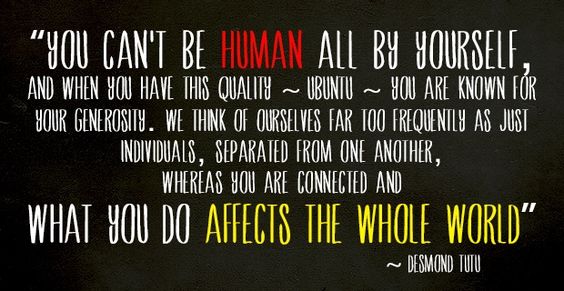
 Just recently I have been asked by a lovely young woman if I will be her “older Christian friend”. I was very touched and said “yes” and then didn’t think much more about it. God gave me a nudge and convicted me that I need to be seeing her regularly to do some proper discipleship stuff. So I prayed and I pondered and set a regular day and time that works for both of us. I felt God saying that instead of it just being random stuff we should do some Bible study and let the life stuff come from there. So last week we chatted about stuff. I suggested reading a certain book of the Bible but she suggested Romans. Oh my, thought I, I don’t like Romans, but I let it go and thought I’d go with it.
 and it has been amazing. I have found something in those first 3 chapters I never saw before but it has totally deepened how I see God. it has been amazing. Now if I’d been bossy and decided I was the “older” one and so knew so much more where to start and how to do this I would have missed out on so much. Because I acquiesced I have grown in my relationship with God – just in less than a week! Blessed for acquiescing? Maybe 🙂
 When I use to facilitate youth groups, if they were small enough, I would let them have as much autonomy as possible. At one group we ran it like the adult group where the teenagers would bring along food to share. To begin with parents would make the food or buy or be surprised that I didn’t make it all but the teenagers felt like it was their group because they shared the food they had made. It is where I have struggle with larger groups where the leaders have felt they should give to the teens and actually the teens have felt they should be given to.
 actually I have got each actor writing their own piece from their character’s point of view. And again I am learning so much.
 Oh you know I get really fed up of people whether Christian or not going on about how Christmas is a pagan festival. Ok so we know that Jesus probably wasn’t born on Christmas day but what the Celtic church did was show people who were celebrating the return of the sun Jesus within their festival. Also forgive me if I have posted on this before. I feel though it is a bit like the Cliff Richard song “
 e greens” which meant that the church was going to be decorated ready for Christmas. Each part of what happened was explained. So Why do Christians put up evergreen Christmas trees and
 because of the Pax Romana, but also the pagans had become disillusioned with their religion. They were finding that their sacrifices weren’t working and they were having to do more and more human sacrifices to “make things happen.” They were ripe and ready for something to come along to tell them that the ultimate sacrifice had been made. Now that is God being clever again 🙂
 ch deeper
 Interesting thing – I once heard a Jewish person say that they didn’t like the idea of becoming Christian because Christians don’t seem to want to celebrate. Jews find an excuse to celebrate a lot of the time but so often Christians can be quite dour about things. Ok so I’m not a party person but in my own quiet little way I am going to make this a festival to celebrate and enjoy. 🙂
 So when Jesus gets crucified the Bible says that Pilate put up a plaque above Jesus on the cross that said “King of the Jews” and the Jewish leaders who wanted him crucified for this very reason got really angry with Pilate and wanted him to take it down. I’d always thought all that was odd. The reason the Jewish leaders had bullied Pilate into crucifying Jesus was because he had declared himself as king, so they said and “they had no other king than Caesar” is what they said. So why get mad about what was there? But also why did Pilate have that plaque put up anyway?
 special punishment in Roman times but was something they did quite a bit and then they would leave the crucified person there for ages as an example. A bit like we use to do over here and leave the condemned man hanging on the gibbet at the crossroads or in a cage on the side of the city walls, or heads on poles from Tower Bridge. That sort of thing. As an example. And to be a good example it was good to remind people what the crimes were that could get you crucified.
 festival. Amazing!
 I have been reading lots of historic novels set in early Norman/Plantagenet times. This was a time when everyone believed God was sovereign and much of what went on was whether it was “God’s will” or not. But all the way through the characters will say things like “Christ’s teeth”, “Holy Mother of God” and other phrases that invoke God or Jesus in a way that would not be acceptable to many Christians now. In fact only the other day someone was saying to me that you could tell whether someone was really following God as to whether they “used God’s name in vain” was the phrase used.
 reverence but were those Medieval characters doing that? I don’t think they were. In fact the Blasphemy Act of 1650 was only brought in to be used to persecute Catholics during the time of William of Orange and in fact for most of its time was only used to “keep Catholics in their place”. It had nothing to do with saying “Oh God” when either upset or happy about something. In fact this morning I was chatting with a fellow dog walker and he was using “Oh God” as a form of emphasising what he was saying. He wasn’t being disrespectful or showing contempt or lack of reverence for God. He just wanted to make a point stronger.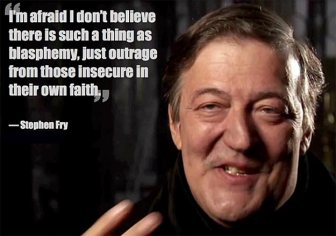

 People talk about how they “gave their lives to the Lord” and then how they have been “going on with The Lord” but people who became Christians at the same time have not “gone on with the Lord“. The key seeming to be whether they have spoken about their faith or not. I have been pondering this; one because I have been wondering if people think I have gone on or not gone on with The Lord.
 my thing – to only speak about my faith if asked. I’m not great at opening up conversation, as I think I explored in one post recently, and so go with where others are leading. Even with friends and family who aren’t Christian I don’t do the whole full on evangelistic thing. I will say that I’ll pray for them or say that I find prayer helps but I don’t think that is saying they “need Jesus.” but I would say that I do.
 my own understanding at times. So “going on with Him“? How can anyone else say?
 not. But that is because, even though I shouldn’t, I still value what other people think of me. Do I think I’ve “moved on with God”? Well I know my relationship with him is very different to what it was in my YWAM days, in my early Christian days, in my days before we even moved up here. Oh yes it has changed considerably. And that is the word for me Change! I’m not sure about moving on/going on but I know for sure that it has changed.
 we die to ourselves, to our own wants, needs, expectations, even wanting to see others come to know Jesus, then we can truly shine. We can stop doing things because we want some form of recognition or someone to fulfil our needs.
 Jesus did as individual salvation and much more about corporate salvation but actually I can only change me and how I look at the world, how I react to the world. So if I die to self and then love others unconditionally there is much more of a chance of me being able to look at things corporately because I will no longer worry about whether someone in my “pack” does something I will be embarrassed about.
 et the Light of God shine in and through me. It will mean I will care for others as God cares for them which i
 I have just started reading “The History of God” by Karen Armstrong. I’ve been wanting to read it for ages but have been nervous about it in case it made me lose my faith in God. I have really only read the introduction and already it has strengthened my faith. Not because she talks about God in a way that makes one want to believe but from her opening paragraph which talks about the difference between belief and faith. She says how she believed in God, enough that for a while she was a nun, but she did not have faith in God, and that none of her studies ever brought her to that place. Even the Bible says that there are many that believe in God, even the devil believes in God, but he does not have faith to live for and with God. Until reading this book I had often pondered what that meant – the the devil to also believe and why Jesus was condemning about it. Now it makes sense.
 due to the things I had to walk through from 2012 I have come to a place of faith in God. I wrote a piece back in January when I was struggling with all the moving stuff and said that I had reached a place where I could really trust in God. Yes true, but I also feel that that was where I went from believing in God to being willing to live a life of faith in God.
 still be loved unconditionally by God, still be able to function. And you know it doesn’t matter if that person hurts me again because I’ve let my guard down, that’s ok. And it doesn’t matter if I do lose it again, reverting to that habit of temper tantrum, because God loves me unconditionally. I have faith that God loves me, but also I have faith in the fact that He doesn’t just love me because I’m ok, He loves me when I’m not ok. I have faith that if I didn’t ever change that would be ok.
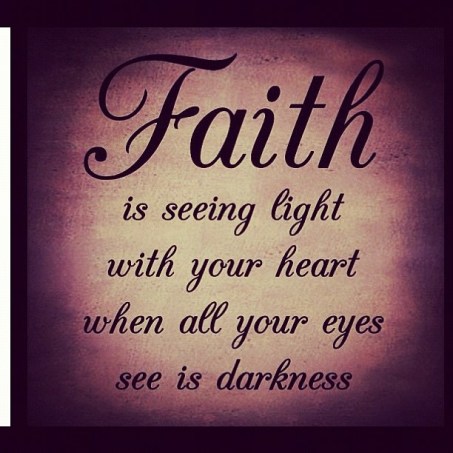 said even the devil believes all those things. But how much faith do I have to trust in God? And I believe this is what I have been learning over the last few years – that it doesn’t really matter what I believe or not. In fact there could always come along something that shatters those beliefs. But am I willing to have the faith to live my life for God?
 And I do wonder if that is the core issue with faith as opposed to believe. Believe is a mind thing that does move to the heart too, but Faith is a heart thing that has to move to the mind. I do have to have faith that God sees I’m doing my best as much as I have faith in Him to lead my life as I believe He would want me to lead it.
 Aspirational Adventures