Categories
harvest mature

Harvest

Photo by Pixabay on Pexels.com

This Sunday was Harvest Festival at our church followed by a church lunch. I’m not sure if all churches do this but ours seems to be pudding filled. So one eats soup and a bread roll then overdoses of puddings and finishes up with a sugar headache later in the day. Or maybe that’s just me.

Anyway our vicar was talking about Harvest and its meanings and I was struck by the parts about how harvest is about bringing in mature crops, crops that were at the end of their growing seasons, and if they weren’t harvested they would go rotten in the fields. These then generate income for the farmer and nutrition/food for both the farmer and whoever they sell their produce to. Harvest is all part of our global economy. Without it we all die – literally. I think for so many of us that buy from shops and supermarkets we lose the importance of this. Even though who do have allotments or grow in their garden they still are not fully reliant on what they produce for their livelihoods or to feed themselves.

With those thoughts in mind it makes this verse seem slightly different –

Then he said to his disciples, “The harvest is plentiful but the workers are few. Ask the Lord of the harvest, therefore, to send out workers into his harvest field.”

Matthew 9:37-38

Now I’ve always taken this, and probably heard it preached, that this meant we were to go out and evangelise the poor lost people, put them on the right track, and teach them about Jesus. But if you think about the crops being mature, being ready, important for the economy and likely to go rotten if not harvested I think it puts a different spin on it.

I wonder if Jesus meant for us to look at people and to see that they were more than ready to be harvested. They weren’t immature people needing us to treat them like they know nothing, but were/are people who know a lot, have a lot to offer and are able to feed us who are already in the church. It is a waste to just bring it into barns and store it for some unknown future. The harvest has to be inputting into the economy immediately. In fact it is integral to the ongoing life of the community.

I wonder too if Jesus’ disciples understood something more than we do when Jesus said this. Back in Jesus time the multitudes who were following Jesus would have believed in the One God who led them out of Israel and made them a people group and would have been looking for the Promised Messiah. Really, I think, what Jesus was saying was that his disciples was that they needed to take these mature crops/people and bring them fully into His Kingdom – which is what happened at Pentecost. When “those who accepted his message were baptized, and about three thousand were added to their number that day” [Acts 2:41] they didn’t have to them go on Bible study courses, discipleship courses, how to be part of our church courses. No. They were accepted as mature and ready and it was left to God the Holy Spirit to train and lead them. Yes it is said they did listen to the apostles teachings [though I wonder if that was just the disciples and those who had travelled regularly with Jesus just saying what had gone on and not a sermon of what had to/had not to be done] but it did not preclude them from being part of things.

I think we need to be looking at those we know, those we come into contact with, and realise which ones are mature and ready to be harvested. Then we need be willing to let them loose into the church and trust that God will do as God knows what’s best to do.

I know one of my biggest frustrations when I first was “harvested” was being held back and told I was not “mature”. According to the description of what harvest is and the Matthew 9 verse those who are harvested are mature and ready to contribute to the life of the Kingdom. Ok they will maybe mess things up a bit, make things a bit untidy because they don’t “know the rules” [which are often manmade anyway!] but is that really such a bad thing?
Categories
Celtic spirituality change choice Godspace harvest St Michael

FEAST OF ST MICHAEL

Today, September 29th, is the feast of St Michael. Here are my thoughts on him.

This post was also published on https://godspacelight.com/2020/09/29/feast-of-st-michael/

imageedit 1 3516209275
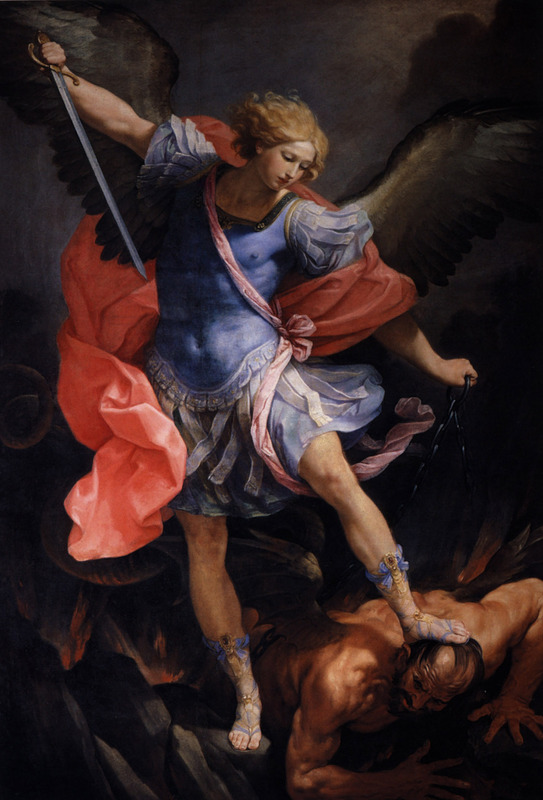
Photo by Guido Reni – http://www.andrewgrahamdixon.com/archive/readArticle/257, Public Domain, https://commons.wikimedia.org/w/index.php?curid=9571452

How do you see St Michael? One of God’s mighty angels? Or, in the UK, a clothing brand by a large department store? [Marks and Spencer’s St Michael’s range] Or as he is depicted in many paintings and church stain-glass windows, the white superhero spearing the brown devil?

Michael, the archangel, Saint Michael, appears all over the place. He’s not just in the Hebrew and Christian Bible, but also in the Quran and in neo-pagan literature, as well as  in countless poems, paintings, statues, music and jewellery. But wherever he appears, he is always strong and invincible.

In the Book of Daniel Michael, the archangel, appears to Daniel and says he is “the protector of Israel” (Daniel 10:13-21) and in Daniel 12:1 saying he will “arise again during the end of time”. In both the Book of Jude (1:9) and in the Book of Revelation (12:7-9), the Archangel Michael is stronger than Satan and defeats and banishes him. In the Quran Sura 2:98 says “Whoever is an enemy to God, and His angels and His messengers, and Jibrail and Mikhail! Then, God (Himself) is an enemy to the disbelievers.” Some Muslims believe that Michael is one of the three angels who visit Abraham (Sura 11:69).

Neo-pagan tradition has leylines, lines of spiritual energy that pass through various points on the land. The most famous one is the St Michael’s leyline; which goes from St Michael’s Mont in Cornwall, through Glastonbury Tor to Bury St Edmunds, Norfolk. There is another St Michael’s leyline from Skelling Michael, Ireland, through St Michael’s Mont, Cornwall to Mount Carmel in Israel.

In Alexander Carmichael’s The Carmina Gadelica, compiled during his travels as in the Scottish Highlands and Islands during the late nineteenth century, 29th September, the Feast of St Michael, was a time for great celebration; with feasting, dancing, visiting the ancestral graves, horse racing, and young people to find a partner. Ray Simpson says in Exploring Celtic Spirituality, every husbandman would give food to the alms-deserving as an offering to “the great God of the elements who gave him cattle and sheep, bread and corn, power and peace, growth and prosperity, that it may be for his abject, contrite soul when it goes thither”. Saint Michael’s feast day was seen as a day of promise to the young and a day of fulfillment for those older, and a day of retrospection to the aged. Carmichael says, “it is a day when pagan cult and Christian doctrine meet and mingle like the lights and shadows on their Highland hills.”

Around the same time Carmichael was gathering his The Carmina Gadelica, the Catholic church in Rome was under persecution from the King of Italy, and the pope wrote this prayer to St Michael.

St Michael’s prayer “Saint Michael the Archangel, defend us in battle. Be our protection against the wickedness and snares of the devil; May God rebuke him, we humbly pray; And do thou, O Prince of the Heavenly Host, by the power of God, thrust into hell Satan and all evil spirits who wander through the world for the ruin of souls. Amen.”

So again I ask, how do you see St Michael? End time deliverer, patron saint of the harvest, the defeater of the devil, a great redeemer, a connector of power lines through the earth? Which one of these Saint Michaels do you want him to be? Or maybe, in these turbulent times, we need him to be all of these – to help us take joy in what we have reaped and what will fulfill us during these times (harvest), defeater of the devil/our enemies, one who can redeem the earth to its purpose, and able to connect the power of the earth to help redeem us from global warming, pandemics, etc.

These are times of great trial, times when we need to look above and beyond, times when we need all the help God has, but also time to rejoice in the good of what is being harvested. Perhaps we do need to stop and reflect and see this day as a day of promise to the young. A day of fulfillment for those older, and a day of retrospect to the aged. Let us pray the prayer but also rejoice and remember that St Michael, and God, are all these things.

REFERENCES:

“Celtic Christian Spirituality: An Anthology of Medieval and Modern Sources” by Oliver Davies and Fiona Bowie  for the quotes from Alexander Carmichael’s The Carmina Gadelica

“Exploring Celtic Spirituality” by Ray Simpson