 I have been reading lots of historic novels set in early Norman/Plantagenet times. This was a time when everyone believed God was sovereign and much of what went on was whether it was “God’s will” or not. But all the way through the characters will say things like “Christ’s teeth”, “Holy Mother of God” and other phrases that invoke God or Jesus in a way that would not be acceptable to many Christians now. In fact only the other day someone was saying to me that you could tell whether someone was really following God as to whether they “used God’s name in vain” was the phrase used.
Now I am not advocating the use of “Oh my God” etc in speech but I was wondering when we talk of blaspheming what is really meant. Again it seems to be a word that has changed meaning, or rather developed a meaning different from it’s dictionary definition.
Blasphemy is the act of insulting or showing contempt or lack of reverence for (a) God(s), to religious or holy persons or sacred things, or toward something considered sacred or inviolable. Some religions consider blasphemy as a religious crime.
So one could say using God’s name as an expletive is showing contempt or lack of 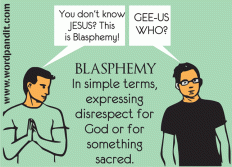 reverence but were those Medieval characters doing that? I don’t think they were. In fact the Blasphemy Act of 1650 was only brought in to be used to persecute Catholics during the time of William of Orange and in fact for most of its time was only used to “keep Catholics in their place”. It had nothing to do with saying “Oh God” when either upset or happy about something. In fact this morning I was chatting with a fellow dog walker and he was using “Oh God” as a form of emphasising what he was saying. He wasn’t being disrespectful or showing contempt or lack of reverence for God. He just wanted to make a point stronger.
Previous to the act of 1650 there were other acts but each of them appear to be used to keep some other group in their place and to be able to punish them under the law whether they were Jews or other forms of Christians that the dominant Christian group didn’t like. So it appears to me that the Blasphemy laws were not kind things, not really loving, and I still think God is love.
So do I agree with the others saying God’s name to make a point? I don’t think I do. But then I also don’t agree with people swearing to make a point. Do I think people are being disrespectful when they use God’s name to make a point? No I don’t. I think it is a way of speech that has been about for hundreds of years. Do I like it? No I don’t. But the question I keep asking myself is why do I not like it? And I keep coming back to the fact that the Christian culture I have been part of for nearly 25 years told me it was wrong and so it has become part of what I think. Do I sometimes use God’s name in a way that isn’t evangelising or praying? Yes I do especially when I get angry. Why? Because sometimes there aren’t enough expressive words to deal with it. So like the Medieval people I have been reading about sometimes I do need to make a point deeper and sometimes that is all there is. Also the other day when there was the most amazing sunset I did also use God’s name to express myself.
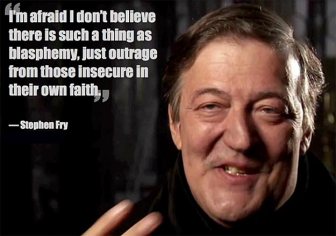
And in following on from the Stephen Fry quote I do wonder sometimes if, as with the laws in put in place over the years whether it was from fear rather than having to defend God. I
do hope God is big enough to deal with any number of people who use His name not in the way He would prefer. I do also wonder how often He takes it literally and as it says in the Bible, both in Old and New Testament, that those who call on His name He will hear and answer.
In my opinion blasphemy is about disrespecting other people’s belief systems whether Christian of any flavour, Hindu, Jew, Muslim, pagan or whatever. And as I finish I wonder, with things hotting up about this EU voting whether we could all deal with it in a way that does not disrespect other people’s belief systems?
 I’ve been pondering this word all week. I believe God has given me a picture of me being like sand on the sea bed after a storm and that I am just to wait until things settle, find peace in who I am and where I am. I love it but …
 risen from the dead and that He says that by following Him they will be connected to God the Father. So … what was there to wait for? Again remember we know the end of the story they didn’t when they went to wait. They did not know that the Holy Spirit that would come then would give them the power to have the courage to go out and defy the authorities, to risk death for what they believed in. It is easy to say that this manifestation of the Holy Spirit helped them heal, etc but when Jesus sent the 77 out whilst he was still alive they came back saying that they had been able to heal and cast out demons. What more did they want? And yet 120 of them waited and …
 the Navigator who set off on a peregrinatio, a journey with no direction just trusting that God would lead. In his journey he goes round in circles a lot and realise at the end that he has to let go of self to really see God, and of course sees God in where he is. Yet he sees more. He is hungry in his wanderings and his waitings and his going in circles to wait for what God will reveal.
 beginnings of the Christian church, for me it has been a time of really looking at these amazing people who were willing to wait and wait for an undetermined time not knowing what would happen next. This waiting is not like waiting for Christmas, or your birthday, or a holiday. Then you know when the date will be. You can count down to it. What would it be like if you didn’t know when something was going to happen and then still waited?
 People talk about how they “gave their lives to the Lord” and then how they have been “going on with The Lord” but people who became Christians at the same time have not “gone on with the Lord“. The key seeming to be whether they have spoken about their faith or not. I have been pondering this; one because I have been wondering if people think I have gone on or not gone on with The Lord.
 my thing – to only speak about my faith if asked. I’m not great at opening up conversation, as I think I explored in one post recently, and so go with where others are leading. Even with friends and family who aren’t Christian I don’t do the whole full on evangelistic thing. I will say that I’ll pray for them or say that I find prayer helps but I don’t think that is saying they “need Jesus.” but I would say that I do.
 my own understanding at times. So “going on with Him“? How can anyone else say?
 not. But that is because, even though I shouldn’t, I still value what other people think of me. Do I think I’ve “moved on with God”? Well I know my relationship with him is very different to what it was in my YWAM days, in my early Christian days, in my days before we even moved up here. Oh yes it has changed considerably. And that is the word for me Change! I’m not sure about moving on/going on but I know for sure that it has changed.

 we die to ourselves, to our own wants, needs, expectations, even wanting to see others come to know Jesus, then we can truly shine. We can stop doing things because we want some form of recognition or someone to fulfil our needs.
 Jesus did as individual salvation and much more about corporate salvation but actually I can only change me and how I look at the world, how I react to the world. So if I die to self and then love others unconditionally there is much more of a chance of me being able to look at things corporately because I will no longer worry about whether someone in my “pack” does something I will be embarrassed about.
 et the Light of God shine in and through me. It will mean I will care for others as God cares for them which i


 Velveteen Rabbi talked of our light in “
 And people will give out a little light or a lot but I can miss both if I am not really looking. As with the different skies each day on my walk, that I can choose whether I engage with or not, I can do the same with people. I can choose to engage with them and maybe then, like the the tall street light, see something in them that I had not seen before even though I had known them a long time.
 I have just started reading “The History of God” by Karen Armstrong. I’ve been wanting to read it for ages but have been nervous about it in case it made me lose my faith in God. I have really only read the introduction and already it has strengthened my faith. Not because she talks about God in a way that makes one want to believe but from her opening paragraph which talks about the difference between belief and faith. She says how she believed in God, enough that for a while she was a nun, but she did not have faith in God, and that none of her studies ever brought her to that place. Even the Bible says that there are many that believe in God, even the devil believes in God, but he does not have faith to live for and with God. Until reading this book I had often pondered what that meant – the the devil to also believe and why Jesus was condemning about it. Now it makes sense.
 due to the things I had to walk through from 2012 I have come to a place of faith in God. I wrote a piece back in January when I was struggling with all the moving stuff and said that I had reached a place where I could really trust in God. Yes true, but I also feel that that was where I went from believing in God to being willing to live a life of faith in God.
 still be loved unconditionally by God, still be able to function. And you know it doesn’t matter if that person hurts me again because I’ve let my guard down, that’s ok. And it doesn’t matter if I do lose it again, reverting to that habit of temper tantrum, because God loves me unconditionally. I have faith that God loves me, but also I have faith in the fact that He doesn’t just love me because I’m ok, He loves me when I’m not ok. I have faith that if I didn’t ever change that would be ok.
 said even the devil believes all those things. But how much faith do I have to trust in God? And I believe this is what I have been learning over the last few years – that it doesn’t really matter what I believe or not. In fact there could always come along something that shatters those beliefs. But am I willing to have the faith to live my life for God?
 And I do wonder if that is the core issue with faith as opposed to believe. Believe is a mind thing that does move to the heart too, but Faith is a heart thing that has to move to the mind. I do have to have faith that God sees I’m doing my best as much as I have faith in Him to lead my life as I believe He would want me to lead it.

