I love the Christian Holy Week, or as the literal Welsh translation calls it “The Great Week”, that week from Palm Sunday through to Easter Sunday. I can see myself in so many of the characters – part of the crowd that gets excited because everyone else is excited on the Sunday. I often don’t need to know what’s going on to get emotionally involved – to cry at a single musical theatre song, to cheer when someone wins something even if I’m not sure of the event. People’s emotions connect with me, which means I could also see myself as part of the angry mob too because I could so easily get caught up with the moment.
I can understand why the disciples asked Jesus why he was curing the fig tree, why he trashed the temple, wonder what he was on about when he said the temple would be rebuild in three days; have traveled with him for so long and yet still not got the message.
I could so easily have been Judas, not so much betraying but trying to force Jesus’ hand in, what I saw was a safer or more effective way; could have been Peter who one day totally gets it and calls Jesus Messiah then later on denies him when he’s afraid of the consequences.
Knowing the end of the story I’d love to say that I would have just done the cheering, just done the Messiah acknowledging, not denied, not thought Jesus wasn’t sure what he was doing, would have totally got what was going on. But that’s because I know what happens next.
I realise, if I’m totally honest with myself, if I was there and didn’t know what came next I would be as fallible as the rest of those there. I would have slept when I should have been awake, would have run away when I should have stayed, would have hidden behind locked doors rather than have walked boldly.
So this year as I listen to the Bible Society read to me the The Great Week stories – I try to remember how fickle and fallible that I truly am. And then remember that God knows that anyway and loves me unconditionally anyway.
Abergwyngregyn Nature Reserve, Gwynedd, North Wales. Photographed 2nd April 2024
I want to say a huge thank you for journey with me and my random thoughts through Holy Week and beyond. I don’t know about you but I’ve really enjoyed marking this space and looking at things a bit differently. I’m not sure about you but for me, sometimes, to turn things on their side helps deepen my faith, whereas looking at things the same way as I’ve always done can make things a bit stale.
This morning I cemented my Holy week and beyond thoughts by taking myself for a walk at one of my favourite places. It is a walk of about 3-3 1/2 miles and takes about 90 mins. It is by the sea looking across the Menai Straights but with the sounds of the A55 North Wales Expressway and the main Holyhead to Cardiff railway line running always to the other side. It is a place where my dog can be off the lead for the whole 90 mins which I enjoy for him as much as for myself. Also a 3 min drive from the walk is the most wonderful community cafe where the dog gets a free sausage and I get a wonderful breakfast so very much a win-win!
I saw one other person on the whole walk and he was standing peacefully looking out to sea and we just exchanged that polite “Morning” before going back to our own thoughts. I have lots of thoughts from it which I will share later on, maybe.
But I will end these Holy Week and beyond ponderings with a prayer by Walter Brueggemann that Joshua Luke Smith shared on yesterday’s The Main Event email
On Generosity
On our own, we conclude:
there is not enough to go around
we are going to run short
of money
of love
of grades
of publications
of sex
of beer
of members
of years
of life
we should seize the day
seize our goods
seize our neighbours goods
because there is not enough to go around
and in the midst of our perceived deficit
you come
you come giving bread in the wilderness
you come giving children at the 11th hour
you come giving homes to exiles
you come giving futures to the shut down
you come giving easter joy to the dead
you come – fleshed in Jesus.
and we watch while
the blind receive their sight
the lame walk
the lepers are cleansed
the deaf hear
the dead are raised
the poor dance and sing
we watch
and we take food we did not grow and
life we did not invent and
future that is gift and gift and gift and
families and neighbours who sustain us
when we did not deserve it.
It dawns on us – late rather than soon-
that you “give food in due season
you open your hand
and satisfy the desire of every living thing.”
By your giving, break our cycles of imagined scarcity
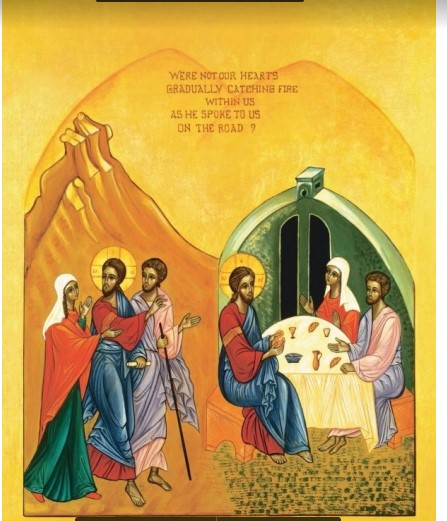
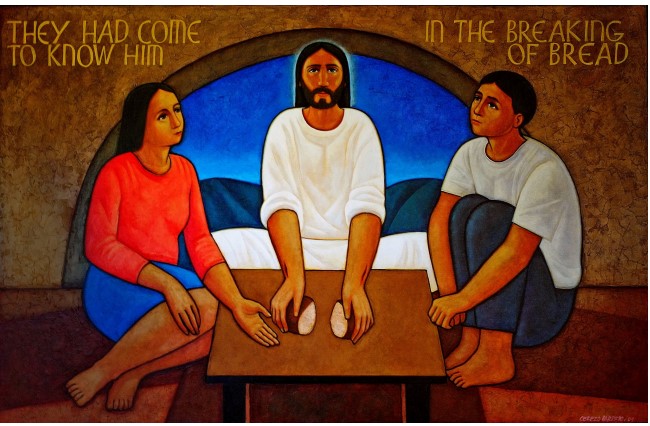
So maybe this happened Easter Sunday but there’s enough going on I thought I’d share this to. Found in Luke 24:12-35
Scholars like NT Wright and Wayne Grudem have argued that maybe Cleopas was walking home with his wife Mary The artists are Sr Marie-Paul Farrar OSB and Maximo Cerezo Barredo who painted several versions of the meal. Thank you to David Pott for bringing this to my attention.
How often does someone take something, decide they are seeing it as it should, gone on to tell others and that has become fact? It isn’t just in preaching from the pulpit but in many areas of life.
In this story it mentions “that same day two of Jesus’ disciples were going to the village of Emmaus”. It then goes on to mention Cleopas by name. Cleopas has never had a mention in any Jesus stories up to now but he is named by Luke the historian as a disciple. The other disciple never gets a name. It also never says if they were traveling just the two of them. They may have been with a crowd of friends who were not classed as disciples by Luke. So to just says “two of Jesus’ disciples” is accurate but not necessarily the whole story. It could have been just Cleopas and a friend; just Cleopas and his wife, who was also a disciple; Cleopas, his wife and a friend, two of whom were disciples; Cleopas with a small group of people heading home dejected after what had gone on, where Cleopas and someone else were disciples.
It amazes me how we are so quick to make assumptions, which with many of the Bible stories then get “set in stone” by years of preaching. And even with this new thought with these paintings and two amazing scholars making us look at it differently. We do still have to be very careful we don’t take this as the true and accurate picture.
The other day a friend of mine was talking about someone who was self-harming. God led me to pray for this person and I was able to suggest an idea to help my friend help her friend. My friend said this was very helpful because this friend of hers was very intelligent and was a retired professional. Well because I’d been told this person was self-harming I had a picture of her in her 20-30s, brassy blond hair with money problems. My friend hadn’t said that. There was nothing in her narrative that told me that but that was my stereotype from the information I have bubbling around in my brain.
So this is why I think we have to be really careful about how we stereotype and pigeon-hole things. Just because the person in authority in church has been telling us this for many years does not make it true.
But as I was reading this story and writing this blog it suddenly struck me – why did Jesus go and meet up with these people; be they 2 or many? What was it about them that was special?
In Luke’s account we have the women going to the tomb with spices and being told by the angel that Jesus was risen. They then go back to tell the “eleven apostles” [Luke 24:12] who think it is nonsense. Though Peter does go to have a look for himself. So why is Luke’s next scene of the risen Jesus with these two disciples on the road to Emmaus – a place that is not named previously and a disciple who is not named previously?
I think this is why we need to really get lost in the scripture. Most of the Bible is not a great way to learn about storytelling because it comes with many plot-holes. But it is an amazing place to not take things as given, to spend time listening to many different opinions but also spend time exploring it for yourself.
And the exciting thing, because the Bible is called the LIVING WORD of God then it will keep changing depending on how you read it and what God needs to highlight for you. Now that is exciting.
Would you have got up at dawn on Easter Sunday to anoint a body that had been dead for 3 days?
I’ve only ever seen one dead body and that was of my sister who had been dead only two days and had something done to her that made her look like she was sleeping. I know there are some traditions where burial is an open coffin but again the body had been preserved and made to look nice. This was Palestine in spring. I’m presuming the women knew Joseph of Arimathea had taken Jesus’ body and laid it in the tomb was because they did know where to go.
I still think they were really brave to be willing to go to deal with that level of decay, to speak with Joseph of Arimathea- not just a man but who was probably above their station. Jesus is continuing his ministry, even in death, of breaking down gender, cultural and class barriers.
Now as we know from an article I wrote a while back, I love a good sunrise. But I like that because it is my time out, my time to connect with the world, my time alone. Would I have wanted to visit the tomb of my friend who I had seen murdered on a cross for all to witness knowing there would be guards around? But also I think there would be other people there too. I don’t think the women who went to Jesus’ tomb were the only people to go to their loved ones to either anoint their bodies or just be visit their grave.
I do think we often think it was just the women, however many of them it was, who were there. Like no one else would have died over that period. Like no one else would have had to be buried quickly because of the Passovers.
We build up this serene picture of the Marys and maybe a couple of other women, going to this garden type place, as the sun rose and there being no one else about.
I think Mary didn’t recognise Jesus because she wasn’t looking at him because he was one of many others there. She was not surprised or perturbed that there was a gardener in this graveyard. I do think she only spoke to him because he was walking alone. I don’t think she even looked him in the face. It was him speaking her name that made her look up at him and really see who it was.
How often do we walk around and not really see? We don’t see the pain, the love, the fear, the masks, etc on people because we have our heads down dealing with our own sh*t, our own losses and grievances, wanting our own questions answered – which is where Mary was when she asked this man if he knew were Jesus was.
The other day I bumped into an older lady I hadn’t seen in ages and as we were chatting. I don’t know how it came about but said something along the lines of how her eyes are dry where she is crying often. [She lost her husband 4-5 years ago and her daughter 2-3 years ago] and I just made some joke about how when I laugh I cough. I was thinking of something else, wanting to get to the park in the hope of bumping into a friend, and had just stopped to make polite conversation. I was not really looking at her. I was not really listening to her. I wonder how often I do that and God doesn’t highlight it for me?
We all are busy. We all are caught up in the moment. I think we are often too frightened to be vulnerable ourselves so we hide behind our control.
To me this whole scene around Jesus’ tomb talks about going where we feel called no matter who else is about, not being afraid to ask the questions even if we don’t know who we are really asking them of, but then being willing the whole time to keep our heads up, our eyes open, be really present in that moment and who knows what or who we might really see.
In churches across the country today the person at the front will say “He is risen” with the congregational response of “He is risen indeed” but I have started doing my best to say that every morning. Jesus did rise on Easter Sunday but he is now fully risen all the time which means for me to really see him and all his amazingness I need to be continually in the moment of knowing “He is risen indeed” and being able to be vulnerable, to not need to control the situations but to just see what happens.
Taken at Easter 2022 on my local beach and in my local park. Abergele, Conwy. Photographed by myself
Easter Saturday is the day in churches where the altar is stripped, where the church is laid bare, where things wait. But I believe during that space between crucifixion and resurrection Jesus was really busy. As Henri Nouwen says in a recent mediations
I don’t think you’ll ever be able to penetrate the mystery of God’s revelation in Jesus until it strikes you that the major part of Jesus’ life was hidden and that even the “public” years remained invisible as far as most people were concerned. Whereas the way of the world is to insist on publicity, celebrity, popularity, and getting maximum exposure, God prefers to work in secret. You must let that mystery of God’s secrecy, God’s anonymity, sink deeply into your consciousness because, otherwise, you’re continually looking at it from the wrong point of view. In God’s sight the things that really matter seldom take place in public. . . . Maybe, while we focus our whole attention on the VIPs and their movements, on peace conferences and protest demonstrations, it’s the totally unknown people, praying and working in silence, who make God save us yet again from destruction.https://henrinouwen.org/meditation/ 26th March 2024
One of those “majorly hidden” parts was during those three days.
As a child I found the whole thing that Jesus says he’ll be in the tomb for three days and three nights but that the church calendar had him only dead for two nights and a half day on Friday, a full day on Saturday and then he was up really early on Sunday. That is not three days and nights at all.
Apparently as the church got more organised it decided to have Jesus crucified on a Friday and risen on a Sunday to stop people being idle for too long.
Until the 4th century, Jesus’ Last Supper, his death, and his Resurrection were observed in one single commemoration on the evening before Easter. Since then, those three events have been observed separately—Easter, as the commemoration of Jesus’ Resurrection, being considered the pivotal event.
I heard one time that when Jesus died it was a time when there was more than one Passover at the same time. So the regular Passover to celebrate the exodus for Egypt but also the Jubilee Passover when slaves were set free, land was allowed to lie fallow, debts were cancelled, etc. – which seems about right with what Jesus was saying he was all about. As well as a regular Shabbat.
So if we move Jesus death forward by a day – at the start of the Jubilee Passover – then get the three nights before he rose again. But we also get the Jewish peoples thinking about not just being freed from slavery but the whole redemption thing that goes on with Jubilee. As well as the whole resting and trusting God to sort things – which can be easy to say when we’re in a good place but remember these people were oppressed.
So over what is now known as Easter Saturday which is a bit of a down day it was the time period – of probably 3 days and nights – when Jesus was battling with various things that stop us trusting and believing in God – slaves to our own ways of thinking and being, to our own issues and ways of dealing with life, caught up in our own debts and over work of ourselves and our land.
Whether Jesus was battling a real life devil and gaining those keys of hell from that devil we will never know, but there is enough “sh*t” in all of us that needs battling with to set us fully free that Jesus would have his work cut out there.
So instead of using this is an “oh my what do I do with it day” I’m going to do some journaling and free writing around what things I need to battle with in my life and hand over the Jesus. Remembering all the time that he has already won the battle but he won it in secret.
In the gospel of Matthew [Matt 27:46] Jesus is quoted as saying Psalm 22 “My God, my God, why did you forsaken me?” which has allowed for many debates, books, and sermons about what was really going on that this moment of Jesus’ crucifixion and why Jesus said those words and why he felt/was abandoned by God.
But what if he didn’t actually say those words! Have a conversation with someone and then an hour later both of you sit down and write down what was said. I bet both accounts are different.
Here’s a thing – when one writes historical fiction the writer only has so much to go on and so will, using the information they have from many sources, will put words into the historical character’s mouths. These are real people who did say real things but maybe not as is written in the books.
But what if that is the same with Jesus? Jesus, I believe, is a real historical person who really did stuff, who really died and really did rise again. But I’m not 100% sure he said what he is quoted as saying.
Each of the gospel writers has an audience they are writing for so each pulls in from difference sources the message they want to convey; the same as all writers do. Also every thing about Jesus came from memory because I don’t think anyone understood really who he really really was until after his resurrection.
To go against this feeling of God forsaking him on the cross Henri Nouwen says
Jesus suffered and died for our sake. He suffered and died, not in despair, not as the rejected one, but as the Beloved Child of God. From the moment he heard the voice that said, “You are my Beloved, on you my favor rests,” he lived his life and suffered his pain under the Blessing of the Father. He knew that even when everyone would run away from him, his Father would never leave him alone.
Henri Nouwen DAILY MEDITATION | MARCH 20, 2024
I think instead of saying “this is what Jesus really said” we need to say “this is what the gospel of Matthew quotes Jesus as saying” and we then wonder what Matthew’s reasoning behind that was. Did Matthew feel that way when Jesus was crucified?
Nouwen is saying, and does in many of his meditations, that once one knows one is a beloved child of God, loved unconditionally, then one knows that even when one screws up God doesn’t leave. Read Job. He knows that no matter what God is God doing God stuff that Job will never understand.
Maybe Matthew misquoted or had an agenda in his gospel writing that we do not know today. Don’t you wish you could talk to the gospel writers, all of them even the ones the early church didn’t put in the Bible, and ask them why they wrote what they wrote and what it meant to them?
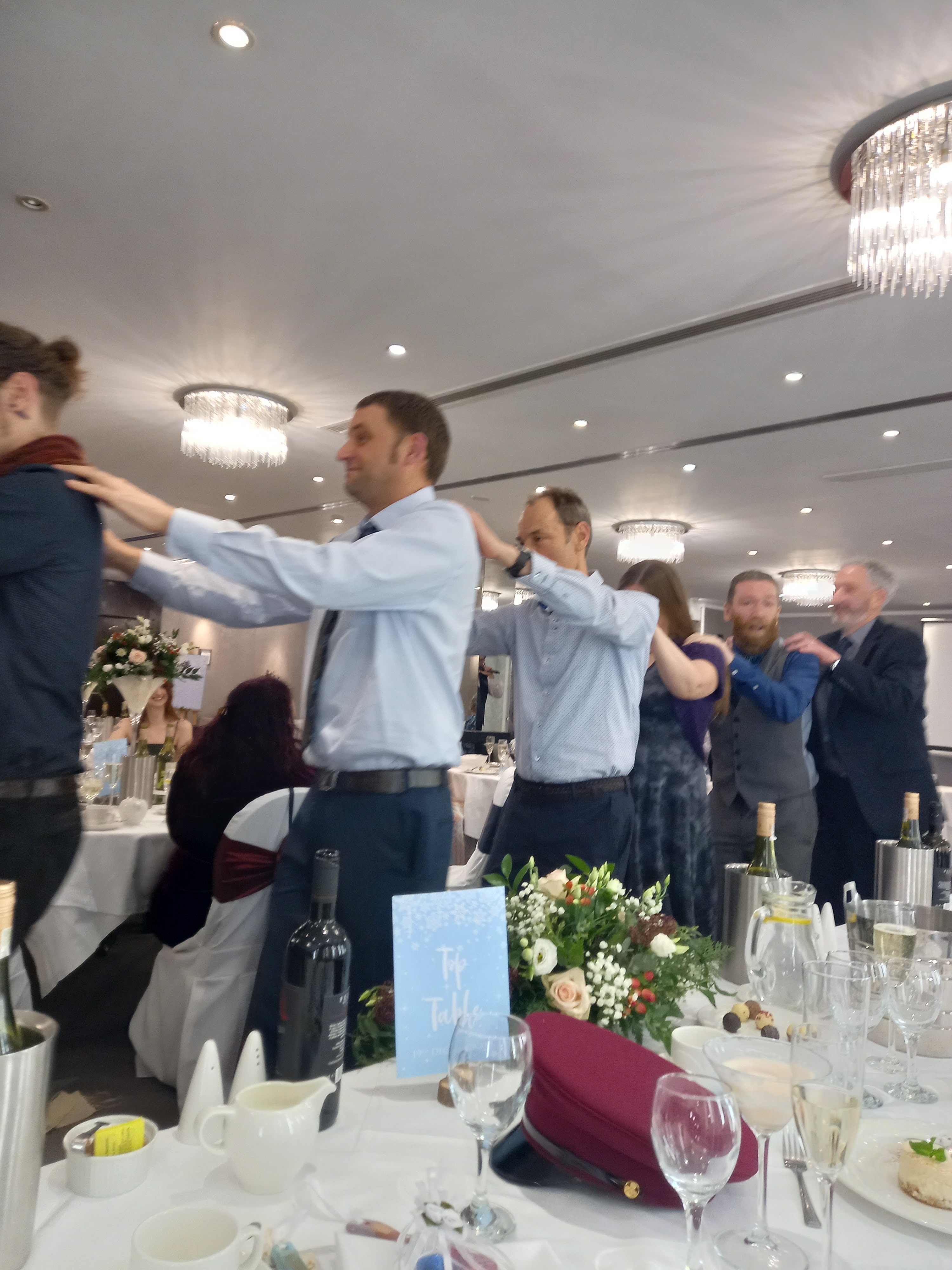
I think it was a much more chaotic affair with families and friends and children and noise. The nearest I could get from my photos was when they did the conga at my son’s wedding back in December 2021. Some people loved it. Others really did not. And I think the goings on at that meal would have been similar. Some would have loved it and some would have not. Maybe they wanted to hear Jesus and someone was chatting. Maybe there were kids charging about as kids can be known to do. Perhaps that was why John was leaning on Jesus chest. Not as a sign of affection but so he could hear properly!!!
I am a bit of a planner, especially when it comes to an occasion. My son and his wife were planning their wedding for nearly a year, and much of that was so they could get the venue they wanted. How many of us on a lovely Sunday lunchtime struggle to find a pub or restaurant that is free because there are only limited spaces and other people have booked in advance?
For me one of the amazing things on this Passover day is that it is only on the actual day that the disciples say “Where do you want us to prepare the Passover meal?”.
Now we know Jerusalem is packed full of people because of the crowds who greeted Jesus on Sunday and then those who shout “Crucify him” later on. This is a big celebration where families come to be together. I’m wondering if the disciples’ families had come to join them too? It would be wrong almost to celebrate this huge occasion in the Jewish calendar away from your loved ones, I think. Also would Jesus have done this big reveal to just the clique of 12 or would he have wanted to include all those people who were not in the chosen 12 but had been following and supporting him for the years of his ministry? So we’re possibly looking for a venue and food for between 13-100 people. But nothing has yet been arranged.
Now as a planner, the one who says to my husband on a Saturday afternoon that if we are thinking of having Sunday lunch out we should book somewhere on said Saturday afternoon, would have struggled not having a place to go. But had everyone got to that point, remembering things like the feeding of the 5000, etc, where they trusted Jesus that he would come through with something.
Perhaps they had learned from the tale of Mary and Martha where Martha is told she is worrying too much about other things, about preparing, when being with Jesus and listening with him is the most important. So they believed by now that Jesus would come through. Trust! Belief!
We don’t know who the two disciples were that finally asked what the plan was for that evening. Though in Luke it says it was Peter and John [Luke 22:7-13]. But when Jesus tell them to “follow a man carrying a water jar” [Mark 14:13] they don’t say “what???” as many of us might do. They trusted and obeyed.
But it is not just his disciples/followers who trust but that of the man who owns the room where they have the Passover meal. We are not told who he is or how he fits into everything [plot hole!!] but whoever he was he had kept his room free for whatever reason when there must have been people clamoring for it. He could also get hold of and prepare enough food for the 13-100 of them that came.
For my son’s wedding we had to give our menu choices about two weeks previous so the hotel could get everything in and prepare it. We were about 35-40 people in total for the main do. And even for the meal with just family before the wedding [about a dozen of us] we still had to have our menu choices in a couple of days early. But on the day Jesus says “yup this is the time and this is where it will be” and everything comes together in time.
I did first think of how long the lamb would take to cook but have you ever made flat breads and salads of bitter herbs? These things are really time consuming – especially if it was for so many people. But it was done and done well. Well enough that Jesus had time to explain what was going to happen next.
For me my “lesson learned” is to not expect to know in advance. The more I’ve gone through healing I’ve realised that having to tightly ordered plan for everything is a control thing that is to do with anxieties from past traumas and so I am learning to let it go, learning to trust the process, learning that if it doesn’t happen then the world won’t end.
I wonder if Jesus’ disciples had reached that point of not having to control things [apart from Judas], of not having to have all their ducks in a row, and had got to a point of believing that Jesus would make things happen as they were meant to happen? And if they didn’t happen then that was ok.
I can only hope and pray that I can move more towards that place so that worries are no longer there. Not that I have to give them to Jesus but that they are just no longer there because I live in a place of knowing that no matter what Jesus has it covered – like those disciples appear to have got to with the Passover meal.
My little dog, Renly, and Mikey the greyhound who I walk twice a week. Photographed 25th March 2024 by myself. Both dogs but both not only very different in size but in temperament. Mikey is very nervy and scared of his own shadow whereas Renly would take on the world
I am really enjoying working my way through Holy Week, looking at things differently and see what God reveals to me, and then sharing it with you.
Today the verses read in churches are Judas betraying Jesus [Matthew 26:14-16] and Mary anointing Jesus at Simon the Lepers house [Matthew26:6-13] Interestingly the gospel of John puts Mary anointing Jesus as six days before Passover and the day before Palm Sunday. But I’m going with the Matthew order because it suits my story letting and the point I’d like to make. See we all change things to suit what we would like to say 🙂
So there are three key people in these stories –
Judas, who has followed Jesus for about three years, has been picked as one of the top twelve, knows Jesus intimately, was there when Peter said “You are the Christ”, and yet wants to force Jesus’s hand. It is like he has worked out, though what he has heard from Jesus, what the ultimate goal is, and so he wants to take control, do things his way and move things along a bit. He knows that the high priests want to do something to get rid of Jesus, but I think Judas believes that if he takes control then Jesus will smite all who are oppressing the people. Really following from Jesus’s trashing of the temple the religious leaders were exploiting the people in their worship as much as the Romans were exploiting the people in their regular work life. So Judas had it worked out and “knew” he could sort things out.
Simon the Leper, was high up in society, has money and influence, and sees in Jesus maybe a kindred spirit. He knows this is someone he needs to get in with, to get to know better. He can pick up that there is something about Jesus that he likes and wants more of. So he invites Jesus to a meal to chat with him, to find out more about him, to work out whether he is worth supporting.
Mary, the woman who “wastes” an expensive perfume anointing Jesus. Tradition says she could have been a prostitute but we don’t know, but from Simon’s reaction she isn’t the sort of person who should be messing with the man he might sponsor. We never know where she gets the perfume. It has been said she saved it up from her prostitution work, but that was a lot of perfume so either she was a high-class prostitute or she was quite old. I do like the idea of her being a high-class whore and that some of the men eating with Jesus at the moment, and maybe even Simon himself, had known her intimately and it had been some of their money that had paid towards that perfume. Anyway wherever it came from she doesn’t care. She is so in love with this man and sees so much in him that she wants to just abundantly worship him and not give a stuff what anyone else things.
So we have
The believer who wants things done their way
The almost believer who wants more proof before they commit
The abundant worshiper who crazily worships without need control, details or proof.
So which one are you? Which one am I?
I would say I’m all three.
Sometimes I get mad at Jesus because I believe I know what the right way would be, what God should/shouldn’t do. But then I and either God doesn’t tell me what I want to hear, or for a situation I don’t get the answers I think are right for that given situation. This is because God see the bigger picture. But I still, at times, would like to force God’s hand.
Sometimes I am wary of committing and would like a bit more proof, please. Like that whole thing of not being open about what I believe, not telling people I’m praying for them. But also at times not praying or doing because I’ve felt I’ve been let down by God before and so I don’t quite trust them.
And then there are times when I need no proof and don’t care what the outcome is or what other people thing but just trust in Jesus and am able to worship with a free heart.
I believe all three of these people appear at this part of the story to help us see who diverse we are. None of these people are wrong [Jesus had to be crucified so it wasn’t Judas who did it but it was God’s plan – another blog maybe???] All were doing what we all do at certain times during our Christian walk – getting mad and trying to control God, wanting more proof, unhindered worship.
I think we need to learn to be kinder on ourselves and realise God knows us fully, loves us fully, died for us fully, and so it is ok to roll between these different ways that we accept Jesus, but also at the end of Monday’s post, come back to forgiving – ourselves, each other, God – and not feel guilty for “getting it wrong again”
Also when I think too often we think of singing as singing. And there is nothing wrong with that. But as when Mary anoints Jesus she is worshiping by making a bit of a spectacle of herself and giving away something important. Sometimes, I think, that for me that can listening to the old ladies I see on my dog walk and not judging, not telling them what they should do, but really listening, and then giving it to God afterwards. Sometimes it is chattering to the birds and the trees and the sea and the sky and telling it how amazing it is.
With Mary it moves back to that thing from Palm Sunday of what would I be willing to give to Jesus in extravagant worship, like with the laying of the coats in front of the donkey?
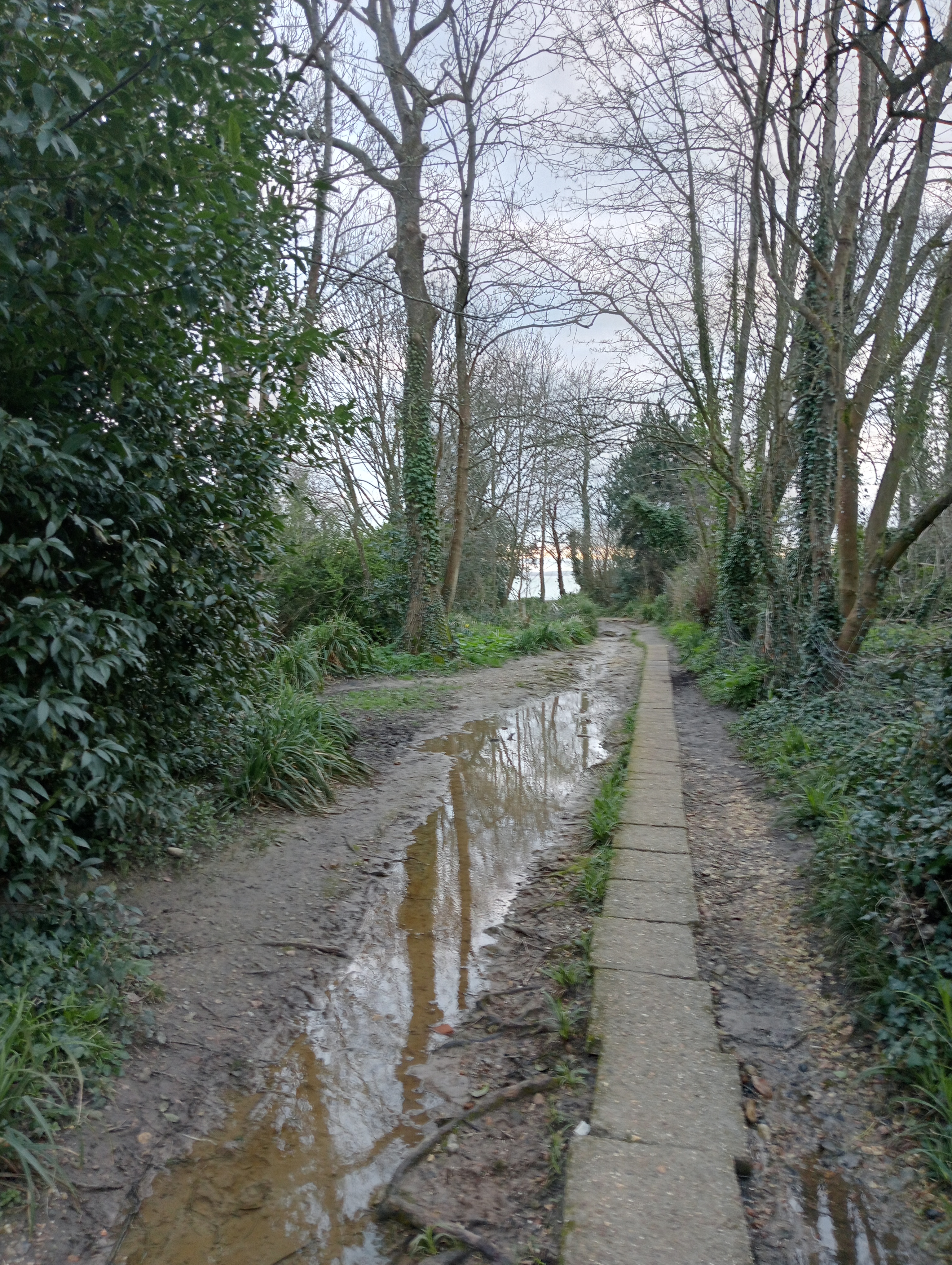
Exploring new paths. Near Ryde, Isle of Wight. Saturday 9th March 2024. Photographed by myself. This is what I hope to do with my look through Holy Week, to explore new paths, and to walk them whether they look inviting or not. I hope you enjoy my journey with me
So as we progress through “Holy week” we reach Tuesday, which is like a down-day. You know that day when you’re on holiday when you’ve done all the best things first because you were so excited to be away then you want to save things for the rest of the week. There is that day mid-week where you just chill out, chat, read books and take stock. Well I think Jesus used this day for just that reason.
This is the day where he spends time preparing his disciples for what is going to happen and how to cope with it all. He explains not just his death but how the worship of God has gone astray in Israel and how he is to redeem it. It is those sort of stories that one hears but probably doesn’t fully understand until after it has happened.
We seemed to spend this past weekend bumping into people who shared about theirs or a close family member’s impending operations or about their parents aging and how they were coping. Most seemed to get the facts but then were in gentle denial about what was really going on. As an outsider it was easier to see more rationally then those closer to the issue.
I think that was the same with the disciples. They could probably have recited everything Jesus had said to someone else but that doesn’t mean they fully understood the implications. They were too close. We, on the other hand, stand 2000 years beyond the events. We know the outcome. But we also don’t have that same relationship with the living Jesus as those disciples did; no matter what we say about having “a relationship with Jesus”. I don’t believe it is the same as the walking physical relationship those disciples had.
So Jesus does his best, as a caring loving friend, to prepare his friends for what he knows to be the inevitable end of this facet of his relationship with them.
As I’ve explored in The Trauma of Grief, there was huge difference in the processing methods of my grief when someone close died traumatically compared to how I coped with the death of my friend from cancer who was able to give away her possessions and say goodbye to everyone. Yes I do have a goodbye email from Tessa sent on the Sunday before she died.
Even though Jesus’s death was humongously traumatic, he used his last fully “down day” to do the equivalent of sending that goodbye email. He did his best to let them know the whys and the wherefores and the whatevers of what he knew was going to happen. I’m sure he did it so that they could grieve his death fully and be ready to be reunited with him rather than them getting stuck in the trauma of grief.
This day isn’t Jesus last time of showing compassion but, as each of the gospel writers writes, it appears to be a day he takes out just for those closest to him.
Could we do that? I hope I can. I hope I’m not too busy wanting to do but can just spend time being with those I love, saying my goodbyes and giving my reassurances. For me this is the lesson I am learning from this day of Holy Week
A wild sea has pulled a bouy from wherever it was attached. For me this is what Jesus does on “Holy Monday”. He causes a storm and pulls things that people were using for protection loose.
My two favourite stories happen on “Holy” Monday. One that no one can get their heads round where Jesus curses the fig tree and then when Jesus really lets loose in the temple and kicks arse.
The cursing of the fig tree is told in one go in Matthew 21:18-22 but in Mark it is split into two halves with the trashing of the temple put between the curse and the explanation, which I think is great story telling. {Mark 11:12-26]
Picture Mark’s storytelling. Get him sat with you in a room. You are gathered round waiting to hear all this. You also know that this is the week leading up to Jesus’ death.
So Mark tells of the glorious peaceful procession into Jerusalem. Then it is like Jesus has one of those blips like we all do when something wonderful has happened. We get grouchy at the deflation of things. How many times have you done something amazing, celebrated your success then felt like you could fight the world the following day? Or is that just me???
But remember Jesus knows that is going to happen in a couple of days time. Or maybe he doesn’t know it is this Passover but knows that his death has to come one a Passover soon and it could be this one.
This past week I’ve had a cough, been shivery and also felt just yuck, but I remembered it was the anniversary of both my sister and my friend’s deaths. Both of which were unexpected and traumatic. My body was reacting and going into fight/flight/freeze mode because it was remembering what was going to happen.
Jesus knew what was going to happen. And I suspect he knew it was going to be this Passover because it is said that this one was a long one [Might explain more in a later post]. The signs were right. I think, if Jesus was truly human then he was scared too.
Anyway he is going into Jerusalem on those days of preparation for this long Passover and sees a tree looking good but with nothing to feed anyone from. Then he turns up at the Temple and it is a mess of capitalism and corruption. Looking good but not feeding anyone. The temple laws are being obeyed – people having to have the right things for the right sacrifices – but it was not being obeyed with the loving heart of God.
Jesus needs things right before he dies. This is not how people should be called into worship and connect with God. They need to be free of rules and be able to come as they are. Jesus was preparing the temple for his death and resurrection. Like giving it a spring clean.
Slight detour but …. before I go on holiday I like to give my house a super clean, tidy, change the bed, having everything tidied, clean and in order. So that when I come back from holiday I come home to a lovely looking house. It is a reason why I don’t have house sitters. They might keep it clean but things won’t be as I’d like them. I do wonder if this is what Jesus wanted with the temple – for it to be spring cleaned and as it should be so that when he rose again the following week things were “in place”.
But also I wonder if he was setting things up so the leaders were angry enough to want to get rid of him. Was this another of those God-plots where God makes sure everything is in place for what they want to do?
I do love how Mark bookends the temple episode with the fig tree. It gets cursed on the way in and then on the way out Jesus use the dead tree as a metaphor to talk about having faith. It finishes with Jesus saying
Whenever you stand up to pray, you must forgive others for what they have done to you. Then your Father in heaven will forgive your sins.
Everything you ask for in prayer will be yours if you only have faith
Mark 11:25-26 and 24
It is great storytelling. Clear out the greed and need for order and to “get things right”. Stop looking good but not being nourishing to others. Then forgive those who’ve done you wrong [people and God] whether they are sorry or not. And then you can ask for anything in prayer with faith. And God will answer you as God knows best. Trusting in your heavenly Father and not in what you think is a good idea.










 Aspirational Adventures