Categories
Holy Week Saturday

Easter Saturday

Easter Saturday is the day in churches where the altar is stripped, where the church is laid bare, where things wait. But I believe during that space between crucifixion and resurrection Jesus was really busy. As Henri Nouwen says in a recent mediations

I don’t think you’ll ever be able to penetrate the mystery of God’s revelation in Jesus until it strikes you that the major part of Jesus’ life was hidden and that even the “public” years remained invisible as far as most people were concerned. Whereas the way of the world is to insist on publicity, celebrity, popularity, and getting maximum exposure, God prefers to work in secret. You must let that mystery of God’s secrecy, God’s anonymity, sink deeply into your consciousness because, otherwise, you’re continually looking at it from the wrong point of view. In God’s sight the things that really matter seldom take place in public. . . . Maybe, while we focus our whole attention on the VIPs and their movements, on peace conferences and protest demonstrations, it’s the totally unknown people, praying and working in silence, who make God save us yet again from destruction.https://henrinouwen.org/meditation/ 26th March 2024

One of those “majorly hidden” parts was during those three days.

As a child I found the whole thing that Jesus says he’ll be in the tomb for three days and three nights but that the church calendar had him only dead for two nights and a half day on Friday, a full day on Saturday and then he was up really early on Sunday. That is not three days and nights at all.

Apparently as the church got more organised it decided to have Jesus crucified on a Friday and risen on a Sunday to stop people being idle for too long.

Until the 4th century, Jesus’ Last Supper, his death, and his Resurrection were observed in one single commemoration on the evening before Easter. Since then, those three events have been observed separately—Easter, as the commemoration of Jesus’ Resurrection, being considered the pivotal event.

https://www.britannica.com/topic/Good-Friday

I heard one time that when Jesus died it was a time when there was more than one Passover at the same time. So the regular Passover to celebrate the exodus for Egypt but also the Jubilee Passover when slaves were set free, land was allowed to lie fallow, debts were cancelled, etc. – which seems about right with what Jesus was saying he was all about. As well as a regular Shabbat.

So if we move Jesus death forward by a day – at the start of the Jubilee Passover – then get the three nights before he rose again. But we also get the Jewish peoples thinking about not just being freed from slavery but the whole redemption thing that goes on with Jubilee. As well as the whole resting and trusting God to sort things – which can be easy to say when we’re in a good place but remember these people were oppressed.

So over what is now known as Easter Saturday which is a bit of a down day it was the time period – of probably 3 days and nights – when Jesus was battling with various things that stop us trusting and believing in God – slaves to our own ways of thinking and being, to our own issues and ways of dealing with life, caught up in our own debts and over work of ourselves and our land.

Whether Jesus was battling a real life devil and gaining those keys of hell from that devil we will never know, but there is enough “sh*t” in all of us that needs battling with to set us fully free that Jesus would have his work cut out there.

So instead of using this is an “oh my what do I do with it day” I’m going to do some journaling and free writing around what things I need to battle with in my life and hand over the Jesus. Remembering all the time that he has already won the battle but he won it in secret.

And it is that secret which is the mystery.
Categories
connecting mental health

Psychological Privatisation

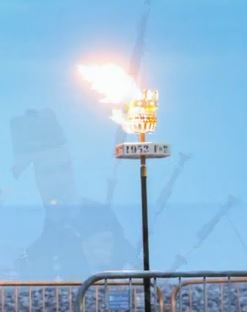
Jubilee Beacon, Pensarn, Conwy

I came across this idea from a Writer’s HQ newsletter and cannot find where to find out much more. This phrase “psychological privatisation” comes from Mark Fisher, who wrote Capitalist Realism: Is There No Alternative?, which I have not read but it is the quote from Goodreads and the paraphrasing from Writers HQ then what happened with the majority of the Jubilee beacons that got me thinking.

Disclaimer – I am not being negative of the Jubilee beacons. I think they were amazing and I loved both the turn out in my town and the whole concept, and the video by George Frost which I have taken this still from. I just think with all these things combined they are saying something about the times we are living in.

So I’ll start with the quote from Mark Fisher that was on Goodreads

“Instead of accepting the vast privatization of stress that has taken place over the last thirty years, we need to ask: how has it become acceptable that so many people, and especially so many young people, are ill? The ‘mental health plague’ in capitalist societies would suggest that, instead of being the only social system that works, capitalism is inherently dysfunctional, and that the cost of it appearing to work is very high.”


https://www.goodreads.com/quotes/9807275-instead-of-accepting-the-vast-privatization-of-stress-that-has

Or as Sarah put it – and I paraphrase the paraphrasing –

Work and life demand too much of us so we are exhausted so we don’t ask our fellow human beings for help, for a better way of doing things. Instead we “try to make ourselves more efficient, push ourselves harder, buy into mindfulness and productivity strategies”, journal more, “and think the problem lies with us and not all the bullshit going on out there.” So we try to be “better” humans, more organised, do more, go faster, earn more, use our leisure time more “wisely”, then all would be fine.

All this stops us being more creative with our solutions and also more connected. It affects our mental health, leaving us more depressed, more anxious, more insular. It also, because we are tired, causes us to accept this crazy status quo and not be able to look for something different. Or even see that this is not working

So then along comes the Jubilee beacons. Now beacons of old were to send messages between communities either to say the enemy was in sight, a monarch was on their way, or as was had a long the North Wales coastline – a series of beacons that said a certain ship had been sighted off the coast of Anglesey and was on its way to Liverpool docks; that it had made a successful crossing. Beacons were for connection and for “passing it onwards.” The ones that happened on 2nd June all did happen at the same time with the same tune played and the same words said. Brilliant. But our little beacon did not see any other beacons and could not be seen by any other beacons. Also once everyone started to go home it was turned off and the burner taken home. There is no residue of a bonfire on our beach, whereas in times past these beacons would be left to burn out so everyone had a chance to see them.

I have a vague memory of lighting Jubilee beacons for the Queen’s 25th Jubilee, but they involved climbing to the top of a hill where the beacons of old were light and then the beacons were light one after the other. It all does happen very quickly.

But I think these beacons this year were a sign of how we are less connected at a deeper level. We are tired after the long pandemic, Brexit, strange election results in this country and the US, a war in Ukraine, the instability of life. Even with regard to the monarchy there is an instability. the Queen is not going to live much longer and then what? We don’t know. And when we try to talk about it we talk without listening.

I think the beacons were a sign. They were wonderfully organised, were efficient, used people’s time “wisely” but actually did not connect one community to another. At least not in a deep, supportive, holistic, “we need to change what we’re doing” sort of way. No trusting each other to “pass it on”.

Categories
poems Self-Publish

Inspirations From Walking in North Wales

Front cover of my book of poems Inspirations from Walking in North Wales. Photograph from above Aber Falls taken by myself, Diane Woodrow
This is the front cover of my book of poems!

I decided to have a go at self-publishing last week. Man, it is hard work. It took about 20 hours to get the poems all collated, into a PDF, and uploaded on to Amazon’s print of demand page. It is now available on Inspirations From Walking in North Wales for £5 per copy. Though the book is longer than I expect but that is because I’m not good at checking sizes. I would be the person who bought a cheap chest of drawers on ebay only to discover that it was for a doll’s house!

I’m not a great fan of Amazon but, after doing a wee bit of research I decided this was the easiest way to get it out there. I do still need to sort out the e-book but even the support blogs I’ve been looking at say it is difficult.

So why did I decide to go for self-publishing? Those who know me will know I am a bit snobbishly anti-self-publishing. But this weekend coming I am part of the Jubilee Arts Festival Abergele/Gŵyl Gelfyddydol y Jiwbilî Abergele. When the organisers first told me about it they asked if I’d be willing to read some poetry and it was whilst planning that the idea came to me to sort out a book that I could then sell. I am now running a writing workshop instead of reading poetry, which is great but the book is done.

I must say I am very proud of it and I would recommend anyone to do it. It is free to put together – just taking up my time – and I can purchase ones at author’s rates. But because I left it so close to the festival to sort I have had to buy a full price copy so I can have something to show for it. But others are on the way. And I’ve also put together a flyer to share.

I have gone from being anti-self-publishing to now being a bit more pro it. I have a great sense of satisfaction for now seeing my poems with the photographs I took with them [some of which can also be found on My Writing page] in a proper book.

I love The Little Yellow Boat as I would my first born but that was a collaboration and a bit scary because I wanted to get it right for the illustrator too. But then also I think I’ve had a bit more healing of issues to do with success and things like that which probably helps. With Inspirations From Walking in North Wales I feel a bit more confident, a bit more assured, and also dead proud that I have done this on my own.

So from being a “don’t do it” I would say “give it a go” and see what your work looks like in print.